
You wouldn’t build the Atomium on quicksand, and you certainly wouldn’t open a Michelin-starred kitchen in Brussels without first installing fire suppression, gas shut-off valves, and a crystal-clear inventory ledger. Yet, every week, I meet engineering teams trying to deploy mission-critical microservices and autonomous GenAI agents on top of a Google Cloud Platform (GCP) Organization that resembles a Sunday flea market at the Place du Jeu de Balle.
When your cloud landing zone grows organically through console “ClickOps”—a project clicked here, an overly permissive roles/editor granted there, a static service account JSON key emailed over Slack—velocity feels exhilarating for the first six weeks. By month six, however, you hit the wall: security teams freeze deployments because they cannot prove compliance, and the CFO is threatening to pull the plug because the monthly cloud bill looks like an unattributed mystery novel.
The Golden Rule of Cloud Architecture: Innovation needs a rigorous foundation. A well-structured GCP Organization is not bureaucratic red tape—it is the high-speed railway track that lets your teams deploy at 10x velocity while keeping CISOs and FinOps leads smiling.
Let’s explore how to structure your GCP Organization for simultaneous Security and FinOps excellence using the Google Cloud Well-Architected Framework (WAF) and Cloud Foundation Fabric (FAST).
1. The Dual Lens: Why Resource Hierarchy is Your Superpower
In Google Cloud, the Resource Hierarchy (Organization $\rightarrow$ Folders $\rightarrow$ Projects $\rightarrow$ Resources) is far more than a tidy directory tree. It is the foundational control plane where two critical disciplines converge:
- Top-Down Policy Inheritance (Security View): Organization Policies, IAM bindings, VPC Service Controls (VPC-SC), and firewall rules flow downward from the Organization root through Folders to individual Projects.
- Bottom-Up Cost Aggregation (FinOps View): Every BigQuery slot, GKE pod, Cloud Run request, and Vertex AI token rolls upward from Resources through Projects and Folders directly into your Cloud Billing export.
┌─────────────────────────────────────────────────────────────────────────────┐
│                   THE DUAL-PURPOSE GCP RESOURCE HIERARCHY                   │
│                                                                             │
│     [ GCP Organization Root ]   ◄── Org-Level Billing & Audit Sinks         │
│                 │                                                           │
│       ┌─────────┴─────────┐                                                 │
│       ▼                   ▼                                                 │
│  [ Folder: Prod ]   [ Folder: Non-Prod ]  ◄── Env Guardrails & IAM          │
│       │                   │                                                 │
│   ┌───┴───┐           ┌───┴───┐                                             │
│   ▼       ▼           ▼       ▼                                             │
│ [BU-A]  [BU-B]      [BU-A]  [BU-B]        ◄── FinOps Cost Centers           │
│   │       │           │       │                                             │
│  (Projects: App, Data, AI Platform)       ◄── Mandatory IaC Tags & Budgets  │
│                                                                             │
│   SECURITY INHERITANCE FLOWS DOWN  │  💰 FINOPS ATTRIBUTION ROLLS UP     │
└─────────────────────────────────────────────────────────────────────────────┘
If your hierarchy is flat—dumping 200 projects directly under the Organization root—you forfeit both levers. You end up applying security policies project-by-project (guaranteeing configuration drift) and spending days writing fragile SQL regexes just to figure out how much the Retail team spent on staging databases.
2. Our Security Mantra: Protect, Control, Comply / Audit
When designing security into your GCP landing zone, reactive patching is a losing game. Instead, we anchor every architectural decision around a three-pillar mantra: Protect, Control, Comply/Audit.
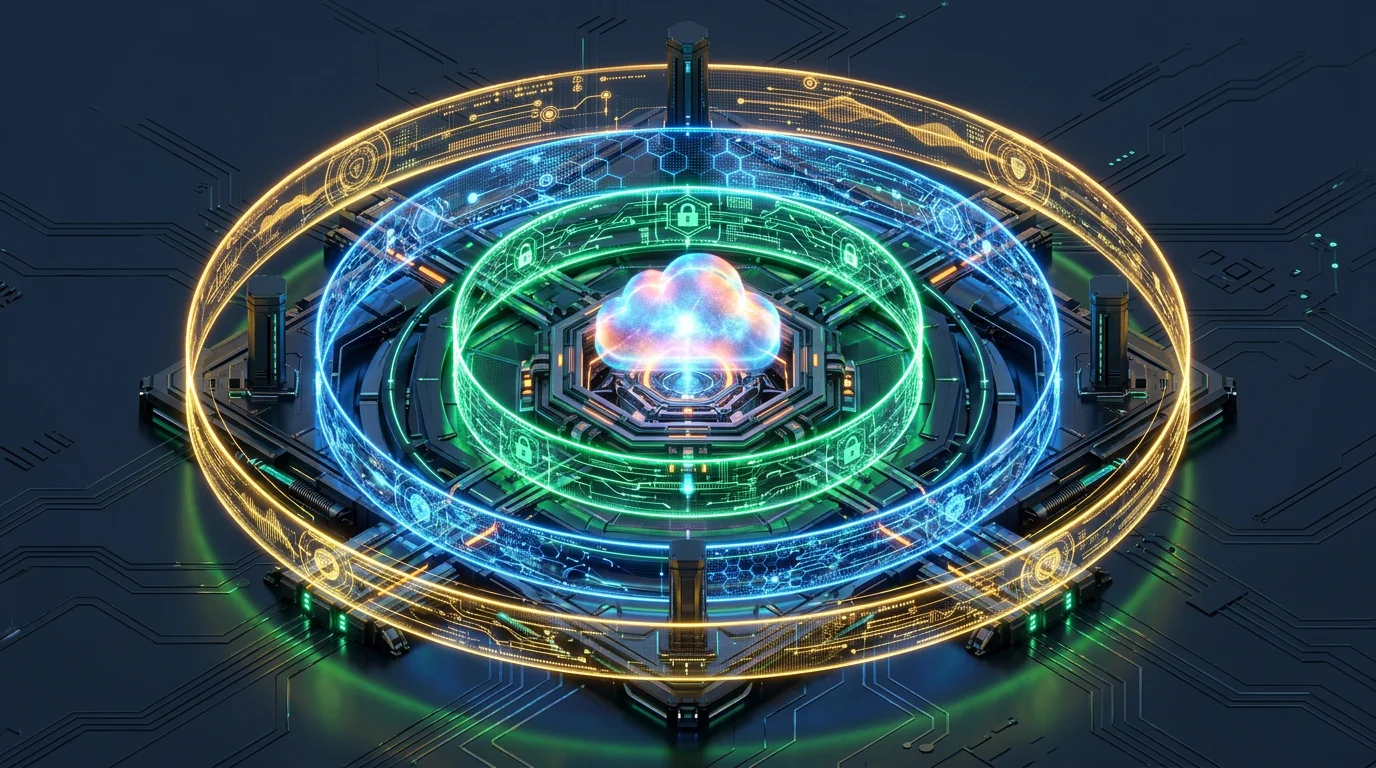
Pillar I: PROTECT (Preventative Guardrails by Default)
Protection is about eliminating entire classes of vulnerabilities before a developer even writes terraform apply. We achieve this through inherited Organization Policy Constraints at the Root and Folder levels:
- Zero Static Keys: Enforce
constraints/iam.disableServiceAccountKeyCreationacross the entire Organization. Static JSON keys are the #1 vector for cloud breaches; ban them at the root. - No Public IPs by Default: Enforce
constraints/compute.vmExternalIpAccessso no VM can accidentally expose an SSH or RDP port to the public internet. All egress flows through Cloud NAT; all ingress flows through Identity-Aware Proxy (IAP) or Cloud Load Balancing with Cloud Armor WAF. - Sovereign Data Residency: For European workloads subject to GDPR, DORA, or NIS2, enforce
constraints/gcp.resourceLocationsset toin:eu-locations(e.g.,europe-west1in Belgium) so data never leaves approved jurisdictions. - VPC Service Controls (VPC-SC): Wrap sensitive data folders (
prod-data,ai-training) inside cryptographic service perimeters that prevent data exfiltration even if an insider credential is compromised.
Pillar II: CONTROL (Least Privilege & Zero Standing Privileges)
If Protect builds the fortress walls, Control governs who holds the keys and how long they can use them:
- Workload Identity Federation: Replace long-lived credentials in GitHub Actions, GitLab CI, or on-prem Kubernetes with short-lived OIDC tokens via Workload Identity Federation.
- Folder-Scoped IAM & Separation of Duties: Network admins manage Shared VPC host projects in the
networkingfolder; data engineers deploy pipelines indata-analyticsservice projects. Neither hasOwnerrights. - Privileged Access Manager (PAM): Eliminate permanent human access to production (
Zero Standing Privileges). When an SRE needs to debug a P1 outage in production, they request a time-bound, audited elevation via PAM with mandatory ticket justification and peer approval.
Pillar III: COMPLY / AUDIT (Immutable Telemetry & Continuous Posture)
You cannot govern what you cannot verify. In an era of strict European regulatory oversight, your audit trail must be unimpeachable:
- Centralized Log Sinks: Configure an Organization-level aggregated sink (
includeChildren = true) that routes all Admin Activity, System Event, and critical Data Access logs directly into a dedicated, locked-downsec-audit-prodproject. - Immutable Retention: Store audit logs in Cloud Storage buckets with Bucket Lock (WORM - Write Once, Read Many) retention policies and stream them into BigQuery for real-time forensic SQL analysis.
- Security Command Center (SCC) Enterprise: Continuously evaluate your live infrastructure posture against CIS Benchmarks, ISO 27001, PCI-DSS, and EU regulatory frameworks—detecting misconfigurations or anomalous container behavior in real time.
┌─────────────────────────┬─────────────────────────┬─────────────────────────┐
│       1. PROTECT        │       2. CONTROL        │   3. COMPLY / AUDIT     │
│  (Preventative Shield)  │    (Access Governance)  │  (Continuous Assurance) │
├─────────────────────────┼─────────────────────────┼─────────────────────────┤
│ • Org Policy Constraints│ • Workload Identity Fed.│ • Org-Level Log Sinks   │
│ • Ban SA JSON Keys      │ • Zero Standing Privs   │ • WORM Locked Buckets   │
│ • EU Location Locks     │ • Privileged Access Mgr │ • SCC Posture & Threat  │
│ • VPC Service Controls  │ • Custom Least-Priv IAM │ • BigQuery Forensic SQL │
└─────────────────────────┴─────────────────────────┴─────────────────────────┘
3. The FinOps View: Turning Architecture into Financial Clarity
Why do CFOs get anxiety attacks over cloud bills? Because traditional cloud invoices tell you what Google Cloud charged you (e.g., $45,000 for Compute Engine, $18,000 for BigQuery), but they don’t tell you who spent it, why they spent it, or whether it generated any business value.
When you structure your GCP Organization deliberately, your architecture becomes a real-time FinOps instrument:
- Folders as Cost Centers: By grouping projects under Business Unit folders (
retail,payments,platform-ai) and Environment sub-folders (prod,dev,sandbox), your BigQuery Cloud Billing export automatically inherits theproject.ancestry_numbersand folder hierarchy. A single SQLGROUP BYgives you instant showback/chargeback per department. - Mandatory Governance Tags via IaC: In GCP, Tags (formerly Resource Manager tags) can be enforced at the Organization level and inherited conditionally. Combined with mandatory billing labels (
cost_center,app_id,owner,environment,data_sensitivity), no resource can be born without a financial owner. - Automated Budget Circuit Breakers: Attach programmatic Cloud Billing Budgets with Pub/Sub notifications to every sandbox project. If a developer accidentally leaves a 64-GPU training cluster running over a long Belgian weekend, a Cloud Function triggers via Pub/Sub to alert the team or gracefully scale down non-production instances.
4. GCP WAF & Cloud Foundation Fabric (FAST): Idempotent IaC
All these security guardrails and FinOps taxonomies sound wonderful on a whiteboard. But how do you actually build, maintain, and evolve them without an army of 50 platform engineers?
The answer lies in the Google Cloud Well-Architected Framework (WAF) and Google’s flagship open-source reference implementation: Cloud Foundation Fabric (FAST).

Why Hand-Rolled Terraform Fails at Scale
Many teams start by writing a single monolithic Terraform repository to manage their GCP organization. Within a year, terraform plan takes 25 minutes, state files are locked in endless contention, and a typo in a dev firewall rule risks breaking production routing.
FAST (Foundational Automated Scalable Terraform) solves this by decomposing your landing zone into decoupled, idempotent stages, where each stage has its own isolated Terraform state, dedicated service account, and strict blast-radius boundary:
┌─────────────────────────────────────────────────────────────────────────────┐
│              CLOUD FOUNDATION FABRIC (FAST) IDEMPOTENT PIPELINE             │
│                                                                             │
│  [ Stage 0: Bootstrap ] ──► [ Stage 1: Resman ] ──► [ Stage 2: Net & Sec ]  │
│  • Seed Org & Billing        • Folder Hierarchy     • Shared VPC Hub/Spoke  │
│  • IaC State Buckets         • Stage Automation SAs • KMS & VPC-SC Perimeters│
│  • Super-Admin Isolation     • Tag Definitions      • Centralized Audit Sink│
│                                                                 │           │
│                                                                 ▼           │
│  [ Compliant GCP Project ] ◄── [ Stage 3: Project Factory (YAML Vending) ]  │
│  • Pre-wired to Shared VPC     • Developer submits 15-line YAML via Git PR  │
│  • FinOps Tags & Budgets       • Idempotent CI/CD applies in < 90 seconds   │
└─────────────────────────────────────────────────────────────────────────────┘
The Magic of Stage 3: The Idempotent Project Factory
The crown jewel of FAST is Stage 3 (Project Factory)—what we call the Cloud Vending Machine.
Instead of opening Jira tickets and waiting two weeks for IT to click through the console, a product team simply submits a pull request containing a 15-line YAML file:
# projects/retail-ai-checkout-prod.yaml
folder_id: folders/8492019482  # Production / Retail
billing_account: 01A2B3-C4D5E6-F7G8H9
labels:
  cost-center: cc-4092-retail
  environment: prod
  owner: team-checkout
  compliance-scope: pci-dss
shared_vpc_service_project:
  host_project: net-prod-host-01
  service_identity_iam:
    cloudservices: [roles/compute.networkUser]
    container-engine: [roles/compute.networkUser]
budgets:
  monthly_limit_eur: 5000
  alert_thresholds: [0.5, 0.8, 1.0]
When the PR is merged:
- Idempotent Execution: The CI/CD pipeline runs Terraform using a scoped Stage-3 Service Account. Because FAST modules are 100% idempotent, running the pipeline once or a hundred times guarantees the exact same deterministic state—zero drift, zero side effects.
- Instant Security Alignment: The project is automatically placed in the
Production / Retailfolder, immediately inheritingProtectOrg Policies, VPC-SC perimeters, and centralized audit log routing (Comply/Audit). - Instant FinOps Alignment: Billing labels, Resource Manager tags, and a €5,000 monthly budget alert are attached from second zero.
5. Summary Matrix: ClickOps vs. FAST Idempotent Foundation
| Dimension | Ad-Hoc “ClickOps” Organization | FAST & WAF Idempotent Foundation |
|---|---|---|
| Provisioning Speed | 2 weeks of Jira tickets & manual console clicks | < 90 seconds via GitOps YAML pull request |
| Security Posture | Reactive firefighting; static JSON keys everywhere | Proactive Protect/Control/Comply baked into folders |
| FinOps Visibility | End-of-month “autopsy” bills with 40% unattributed spend | 100% real-time unit economics by BU, env, and tag |
| Configuration Drift | Constant snowflakes; no two projects look alike | Zero drift via idempotent, stage-isolated IaC |
| Audit Readiness | Panic before every ISO / DORA / NIS2 inspection | Continuous compliance with WORM-locked audit sinks |
📸 Visual Compendium & Architecture Carousel
Explore all three high-resolution illustrations from this architectural guide:
Essential References & Open-Source Blueprints: • Google Cloud Foundation Fabric (FAST) on GitHub • Google Cloud Well-Architected Framework (WAF) Official Documentation