In Brussels, two institutions have historically resisted every attempt to scale to zero: interinstitutional working groups and idle Kubernetes deployments.
Leave a cluster unattended over a quiet weekend in the European Quarter, and you will return on Monday morning to find dozens of underutilized pods faithfully burning vCPUs while waiting for a JSON-RPC payload—the cloud-native equivalent of keeping every chandelier and espresso machine in the Berlaymont running at full pressure in mid-August just in case a rapporteur drops by to file a corrigendum.
Over this morning’s espresso doppio, I have been pairing Eyal Yablonka and Scott Funkenhauser’s announcement of GKE 1.37 native scale-to-zero capabilities with the two infrastructure tracks I have been brewing over the past few days: unifying our hybrid ARM64 edge-to-cloud substrate on netdev-edge and wiring a 12-agent OpenTelemetry & Well-Architected Mission Control across an 11-project cloud fleet.
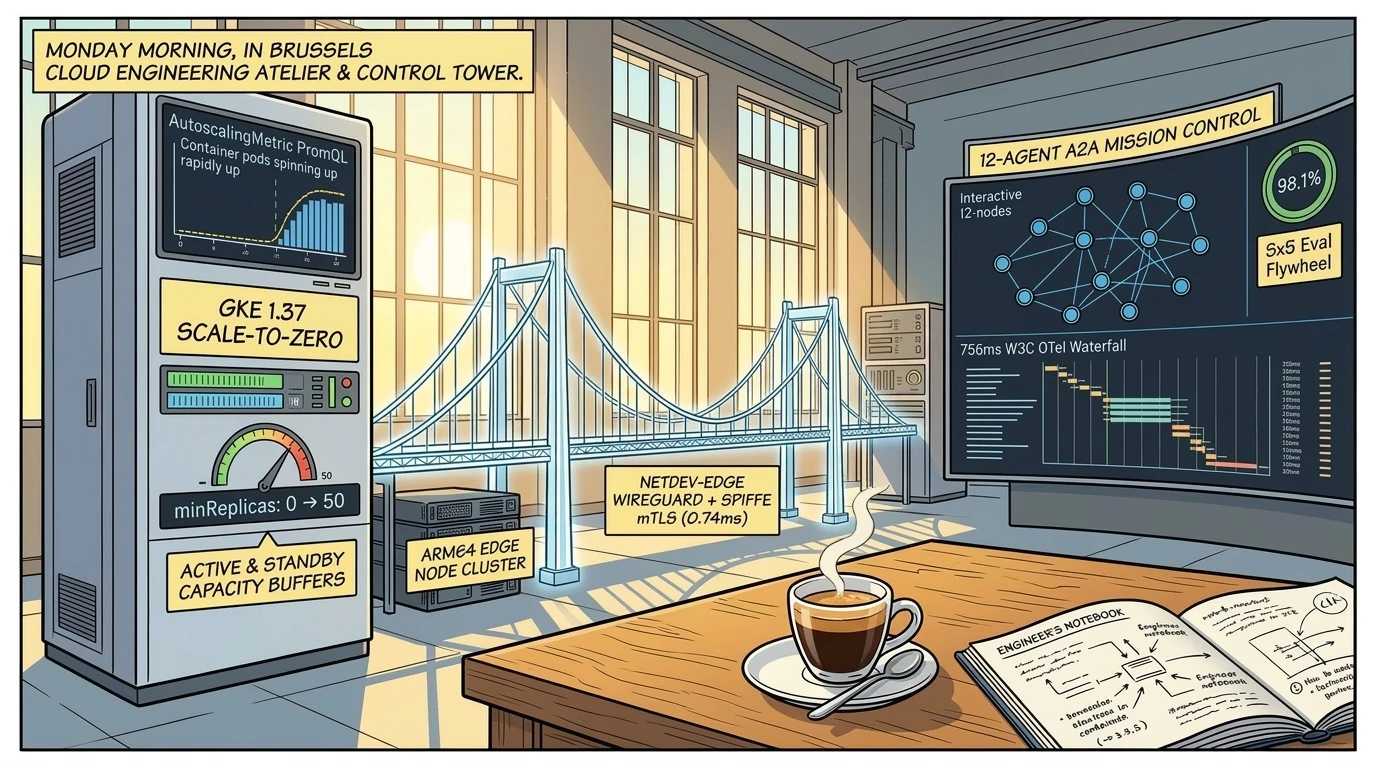 Monday morning in the Brussels atelier: GKE 1.37 native scale-to-zero (
minReplicas: 0 -> 50) with Active & Standby Capacity Buffers on the left, the netdev-edge WireGuard + SPIFFE mTLS bridge in the center, and our 12-Agent A2A Mission Control on the right.
The thesis linking all three is simple: true elasticity in the age of autonomous agents means decoupling the cost of always-on compute from sub-second operational readiness—without ever allowing security, state durability, or observability to go dark.
1. Why GKE 1.37 Native Scale-to-Zero Changes the Equation for Agentic Fleets
Multi-agent systems are bursty by nature. A sovereign procurement agent, a fiscal customs verifier, or a five-node legislative simulator might sit completely silent for forty minutes, then suddenly fan out across six Agent2Agent (A2A) handshakes, three Model Context Protocol (MCP) database queries, and a side-by-side evaluation sweep in under a second.
Until now, achieving minReplicas: 0 on Kubernetes required bolting on external event-driven operators such as KEDA. While capable, external autoscaling operators introduce their own operational gravity: custom ScaledObject CRDs, external metrics adapter hop-counts that inflate cold-start reaction times, and YAML sprawl that easily crosses 10,000 lines across a multi-project fleet.
With GKE 1.37, scale-to-zero moves from sidecar management directly into the GKE control plane through three tightly integrated primitives:
| Architectural Dimension | GKE 1.37 Native Scale-to-Zero | Legacy Add-On Operators (KEDA) |
|---|---|---|
| Control Plane Toil | Fully managed; zero third-party operators or custom metrics adapters to patch. | Requires lifecycle management of external operators and ScaledObject CRDs. |
| Signal Path & Configuration | Native autoscaling/v2 HPA (KEP-2021) + AutoscalingMetric querying Managed Prometheus directly via PromQL. |
Adapter polling intervals and extra network hops increase wake-up latency and YAML footprint. |
Cold-Start Mitigation (0 -> 1) |
Pooled Active & Standby Capacity Buffers eliminate the 60–90s node provisioning wait. | Cold starts block on cluster autoscaler node bring-up unless over-provisioned dummy pause pods are hacked together. |
Under the Hood: AutoscalingMetric PromQL + KEP-2021 (minReplicas: 0)
Instead of routing external signals through third-party adapter pods, GKE 1.37 extends the AutoscalingMetric custom resource (autoscaling.gke.io/v1beta1) to read PromQL queries directly from Google Cloud Managed Service for Prometheus—covering Pub/Sub backlog depth, Cloud Monitoring gauges, or custom A2A task queue metrics—and feeds them straight into a KEP-2021-enabled HorizontalPodAutoscaler (HPA):
apiVersion: autoscaling.gke.io/v1beta1
kind: AutoscalingMetric
metadata:
  name: a2a-agent-task-backlog
spec:
  metrics:
  - promql:
      name: pubsub-a2a-undelivered
      query: >
        pubsub_googleapis_com:subscription_num_undelivered_messages{
          monitored_resource="pubsub_subscription",
          subscription_id="a2a-specialist-task-queue"
        }
---
apiVersion: autoscaling/v2
kind: HorizontalPodAutoscaler
metadata:
  name: a2a-specialist-worker-hpa
spec:
  scaleTargetRef:
    apiVersion: apps/v1
    kind: Deployment
    name: a2a-specialist-worker
  minReplicas: 0
  maxReplicas: 50
  metrics:
  - type: External
    pods:
      metric:
        name: autoscaling.gke.io|a2a-agent-task-backlog|pubsub-a2a-undelivered
      target:
        type: AverageValue
        averageValue: "4"
Defeating the 90-Second Cold Start: Active & Standby Capacity Buffers
Any SRE who has ever put minReplicas: 0 into production knows the catch: the moment the first message arrives, the HPA flips from 0 to 1, finds no schedulable node capacity, and waits 60 to 90 seconds for a new VM to boot and pull container layers. For an interactive A2A agent orchestration with a sub-second SLA, a 90-second pause is indistinguishable from an outage.
GKE solves this with Capacity Buffers in two complementary tiers:
- Active Capacity Buffer (Shared Wildcard Compute): A compact pool of warm compute shared across hundreds of scale-to-zero deployments. Instead of 50 idle agents each hoarding a replica, the active buffer acts as cluster-wide wildcard capacity: whichever agent wakes from
0 -> 1claims warm CPU and memory instantly. - Standby Capacity Buffer (Low-Cost Rapid Refill): Priced at a fraction of active compute, the standby buffer automatically replenishes the active pool the moment a burst of multi-agent traffic claims the initial warm slots.
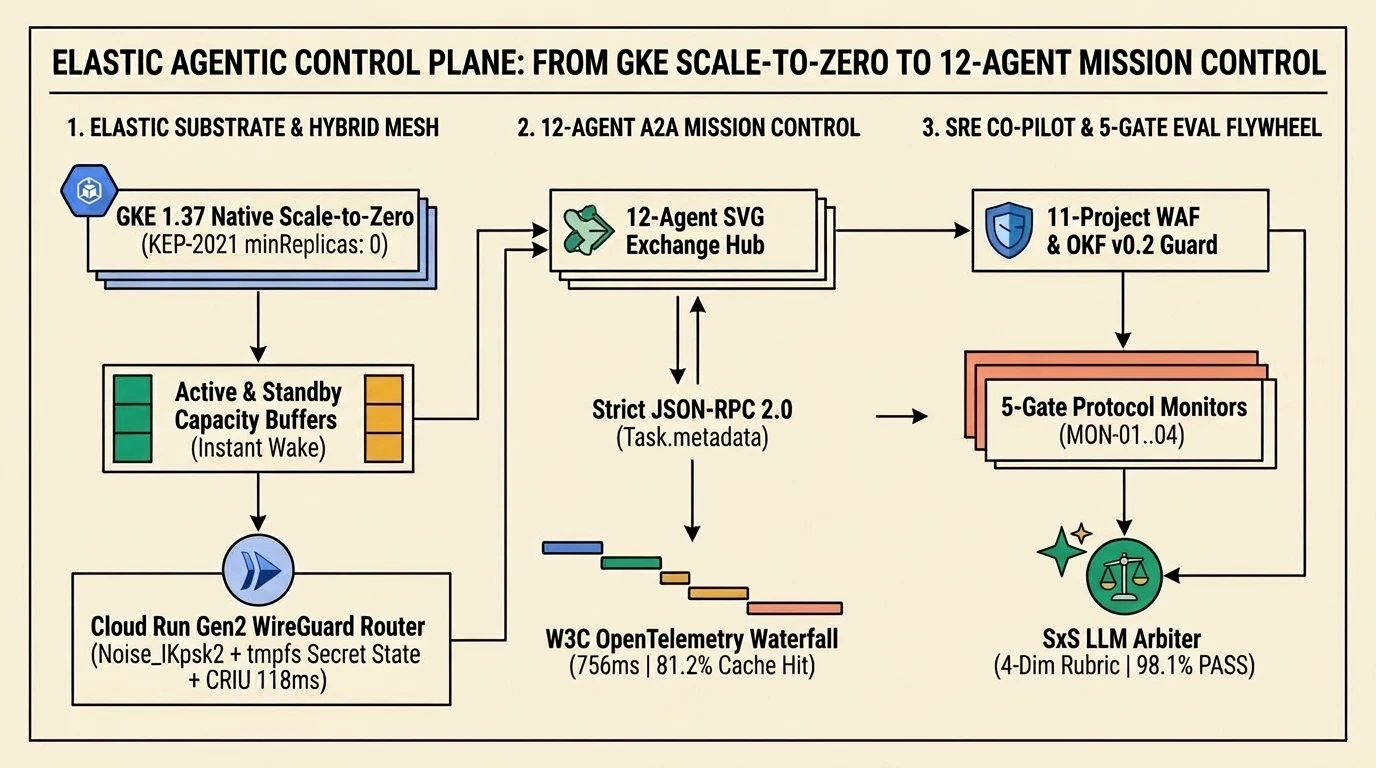 The three-tier Elastic Agentic Control Plane: combining GKE 1.37 Scale-to-Zero and our
 netdev-edge WireGuard router (left) with the 12-Agent A2A Mission Control (center) and the 5-Gate SRE & Evaluation Flywheel (right).
2. Hybrid Scale-to-Zero on netdev-edge: WireGuard Noise_IKpsk2, tmpfs Secrets, and 118ms CRIU Restore
How do you extend that same “zero-idle compute, instant wake-up” discipline across a hybrid edge-to-cloud boundary?
This week in agentic-platform, we completed a major architectural consolidation on netdev-edge (europe-west1): retiring fragmented legacy substrate views, unifying Platform, Deployments, and Infrastructure under a single cockpit, and wiring end-to-end Server-Sent Events (SSE) live telemetry across our React Backstage portal (processing 60-FPS RFC 6902 incremental JSON patches and FlatBuffer binary decodes with zero static mocks).
Our compute topology spans two worlds with 100% linux/arm64 binary parity:
- On-Premises K3s Swarm Mesh: Anchored by our control-plane master (
sweetsixty6), ARM64 worker nodes (rpi,rpj,rpk), a local Tekton build factory (git-clone$\rightarrow$kaniko-build$\rightarrow$trivy-scan$\rightarrow$cosign-slsa3-attest$\rightarrow$ zero-downtime rollout), and a dedicated NAS Write-Ahead Log (WAL) vault (synack). - Elastic Cloud Burst in
europe-west1(netdev-edge): GKE Autopilot ARM64 node pools (Tau T2A / Axion C4A) alongside a Cloud Run Gen2 serverless burst pool scaling elastically from0to50instances.
The Headless Bridge: aether-tailscale-router on Cloud Run Gen2
When cloud worker instances scale down to 0 and burst back to 50 on demand, they cannot afford a multi-second VPN handshake or a stateful split-brain when reconnecting to the on-prem control plane. We engineered the aether-tailscale-router on Cloud Run Gen2 (minScale: 1, cpu-throttling: false), bound directly to our Shared VPC (vpc-netdev-shared, subnet 10.10.2.0/24) via ipvlan-eth1 Direct VPC Egress (all-traffic):
- WireGuard
Noise_IKpsk2& Cryptokey Routing: The router maintains a 24/7 warm 15-second keepalive tunnel (Curve25519ECDH,ChaCha20-Poly1305AEAD,BLAKE2s,SipHash24) with strict Cryptokey Routing binding node keys toAllowedIPs, encapsulated when needed inside zero-knowledge DERP TLS 1.3 streams and wrapped in Layer-7 SPIFFE/SPIRE X.509 mTLS (spiffe://aether.local/ns/edge/sa/router). - Zero-Disk Secret Manager State Recovery (
tmpfs): How do you make a stateless Cloud Run container survive a cold restart without re-authenticating to the mesh or writing private keys to disk? At container boot, the cryptographic node state (_machinekeyand node private keys) is fetched from Google Cloud Secret Manager (TAILSCALE_STATE) and hydrated strictly into an in-memory, root-onlytmpfsmount (/tmp/tailscale.state,chmod 600), withprivate_key_http_redaction: ENFORCEDacross all diagnostic endpoints. - Single-Writer WAL &
118msCRIU Memory Teleportation: To prevent split-brain state corruption when burst instances wake from zero,sweetsixty6acts as the authoritative Single-Writer WAL Master. Waking Cloud Run and GKE Autopilot ARM64 pods auto-discover the master via MagicDNS, forwarding state mutations over the warm tunnel while consuming asynchronous Change-Data-Capture (CDC) WAL streams,14.2µszero-copy Unix Domain Socket IPC (48,290 req/s), and CRIU checkpoint/restore memory snapshots (118msrestore SLA,3.42 GBreclaimed viazswap).
3. The 12-Agent Mission Control: W3C OpenTelemetry Waterfalls & The 5-Gate Eval Flywheel
When your compute layer scales elastically between zero and fifty replicas across edge and cloud, your observability, architectural governance, and evaluation loops cannot scale to zero.
Over the weekend in aicafe-mission-control, we evolved Friday’s live workshop arena into a full Multi-Project Agentic Mission Control governing 12 specialized A2A agents across an 11-project cloud fleet in europe-west1.
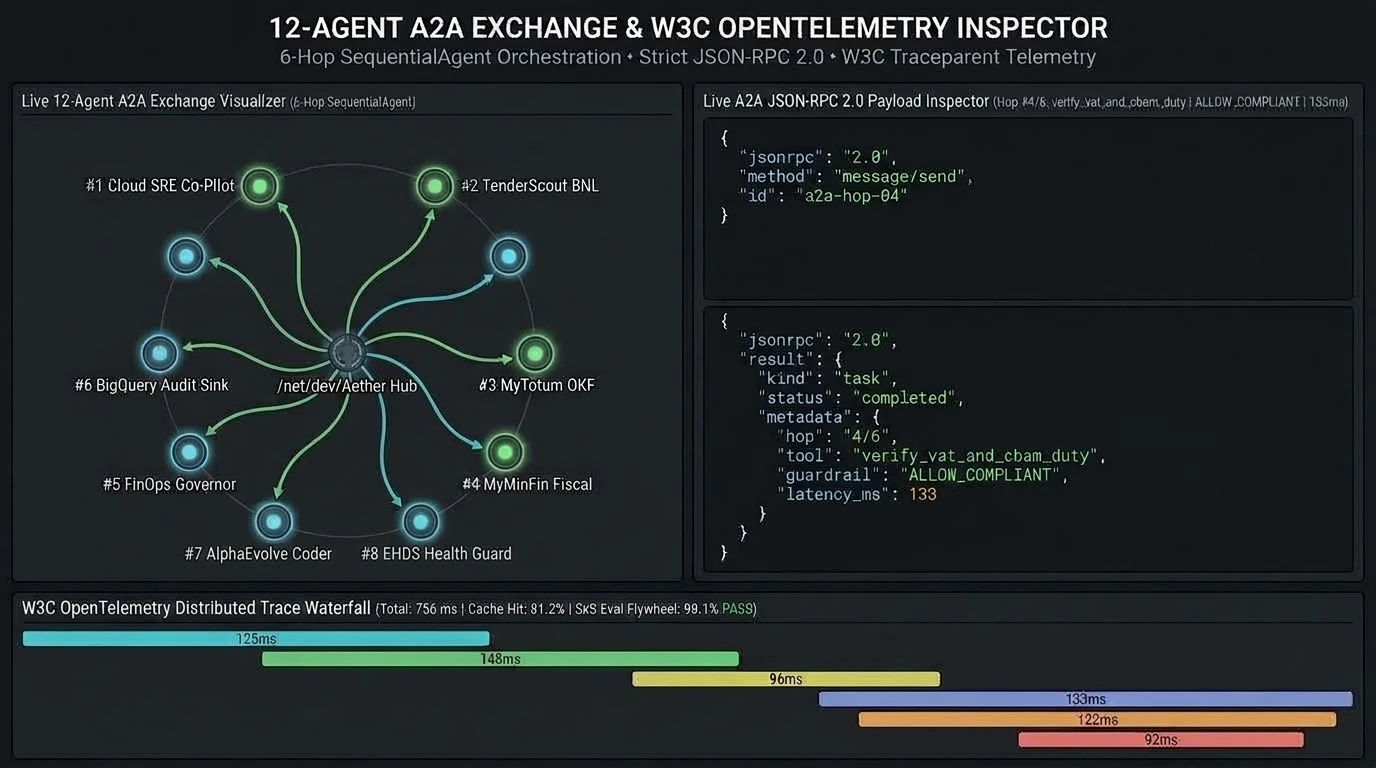 Inside the 12-Agent Mission Control: (Left) Live SVG Exchange Topology orchestrating a 6-hop
 SequentialAgent cascade, (Right) Strict JSON-RPC 2.0 Task.metadata payload inspector, and (Bottom) the 756ms W3C OpenTelemetry distributed trace waterfall.
I. Live 12-Agent SVG Exchange Visualizer & Sub-Second traceparent Waterfall
Rather than treating multi-agent chains as opaque black boxes, the #arena Exchange Visualizer renders all 12 domain agents—including our Cloud SRE Co-Pilot, TenderScout Benelux Procurement Agent, MyTotum Dialectical OKF Graph Agent, MyMinFin Fiscal & CBAM Auditor, FinOps Chargeback Governor, AlphaEvolve Coding Agent, EHDS Health Space Guard, and BigQuery Audit Sink—around the central /net/dev/Aether hub with animated Bezier packet flows across SequentialAgent, ParallelAgent, LoopAgent, and Coordinator topologies.
Clicking any hop in a live 6-agent SequentialAgent cascade exposes the exact W3C OpenTelemetry (traceparent) span timeline (Total: 756 ms end-to-end across six distinct agent hops: 125ms $\rightarrow$ 148ms $\rightarrow$ 96ms $\rightarrow$ 133ms $\rightarrow$ 122ms $\rightarrow$ 92ms), backed by ADK 2.0 ContextCacheConfig achieving an 81.2% semantic cache hit rate and dual-sinking every trace to Google Cloud Trace v2 and BigQuery.
II. Hard-Won A2A Production Lessons: The 5-Gate Continuous Verification Engine
Running 12 real Agent2Agent (A2A) services across an enterprise discovery engine and a multi-project fleet surfaces protocol sharp edges that never appear in localhost demos. We codified those hard-won lessons into four continuous root-cause monitors (MON-01 .. MON-04) and a 5-Gate Verification Suite executing 54 multi-turn evaluation tracks (162 turns) every five minutes:
- Gate 1 ·
MON-01(Direct Cloud Run Egress vs. Proxy Reset): Routing registeredA2Aagents through an cross-region Secure Web Proxy without an explicit gateway security policy URL list triggersHTTP 502 (URX)upstream resets against*.a.run.appbackends. Gate 1 continuously verifies directeurope-west1Cloud Run egress bindings across all 21 registered agent services. - Gate 2 ·
MON-02(Strict Pydantic v2extra="forbid"Envelope Compliance): StrictA2Av0.3 clients validatemessage/sendJSON-RPC 2.0 responses againstSendMessageResponse(Task | Message) withextra="forbid". Attaching custom telemetry keys (otel_trace_id,traceparent, oreval_score_pct) at the JSON-RPC root or top-levelTaskobject triggers an immediateHTTP 400: Extra inputs are not permitted. Gate 2 enforces that all custom OpenTelemetry and guardrail attributes are nested strictly insideresult.metadata(Task.metadata). - Gate 3 ·
MON-03(Runtime/.well-known/agent.jsonStreaming Parity): Because discovery engines fetch{origin}/.well-known/agent.jsondynamically prior to every invocation, advertising a stale hostname or settingcapabilities.streaming: trueon a synchronous JSON-RPC endpoint breaks invocation at runtime. Gate 3 probes live agent cards every 300 seconds to guarantee 100% contract parity. - Gate 4 & Gate 5 ·
MON-04(WAF-Aware &OKF v0.2SRE Co-Pilot +SxSLLM Arbiter): Every trace cross-feeds into our 5-Pillar Google Cloud Well-Architected Framework (WAF) andOKF v0.2SRE Co-Pilot (enforcingokf-cost-4-stageClassify $\rightarrow$ Consume $\rightarrow$ Route $\rightarrow$ Cache andokf-security-5-layerPerimeter $\rightarrow$ Identity $\rightarrow$ Model Armor $\rightarrow$ Tool Governance $\rightarrow$ Audit) and is graded by our deterministic Side-by-Side (SxS) LLM Arbiter across four weighted dimensions:- Goal Completion (
35%) - Tool Selection Accuracy (
25%, with a-3.5penalty on hallucinated or unauthorized tools) - Step Efficiency (
20%) - WAF Grounding & Enterprise Safety (
20%, with a-3.5penalty for0.0.0.0/0egress or static keys)
- Goal Completion (
Across the latest 162-turn fleet sweep, the control plane recorded a 98.1% (2.94 / 3.0) evaluation flywheel score (SxS Δ +1.02, 100% Candidate A win rate).
Brewed Artifacts & Monday Takeaway
Whether you are running bursty background workers on GKE 1.37 with KEP-2021 and Capacity Buffers, bridging ARM64 edge nodes to Cloud Run Gen2 over a headless WireGuard + SPIFFE router, or orchestrating a 12-agent A2A constellation with W3C OpenTelemetry waterfalls, the architectural rule of thumb for 2026 is clear:
Let your idle compute scale ruthlessly to zero—but keep your capacity buffers warm, your cryptographic state in
tmpfs, and yourTask.metadatatelemetry traces wide awake.
Now, if only we could submit a Kubernetes Enhancement Proposal to apply minReplicas: 0 to Monday afternoon committee meetings. Until then, I will settle for a second espresso doppio.