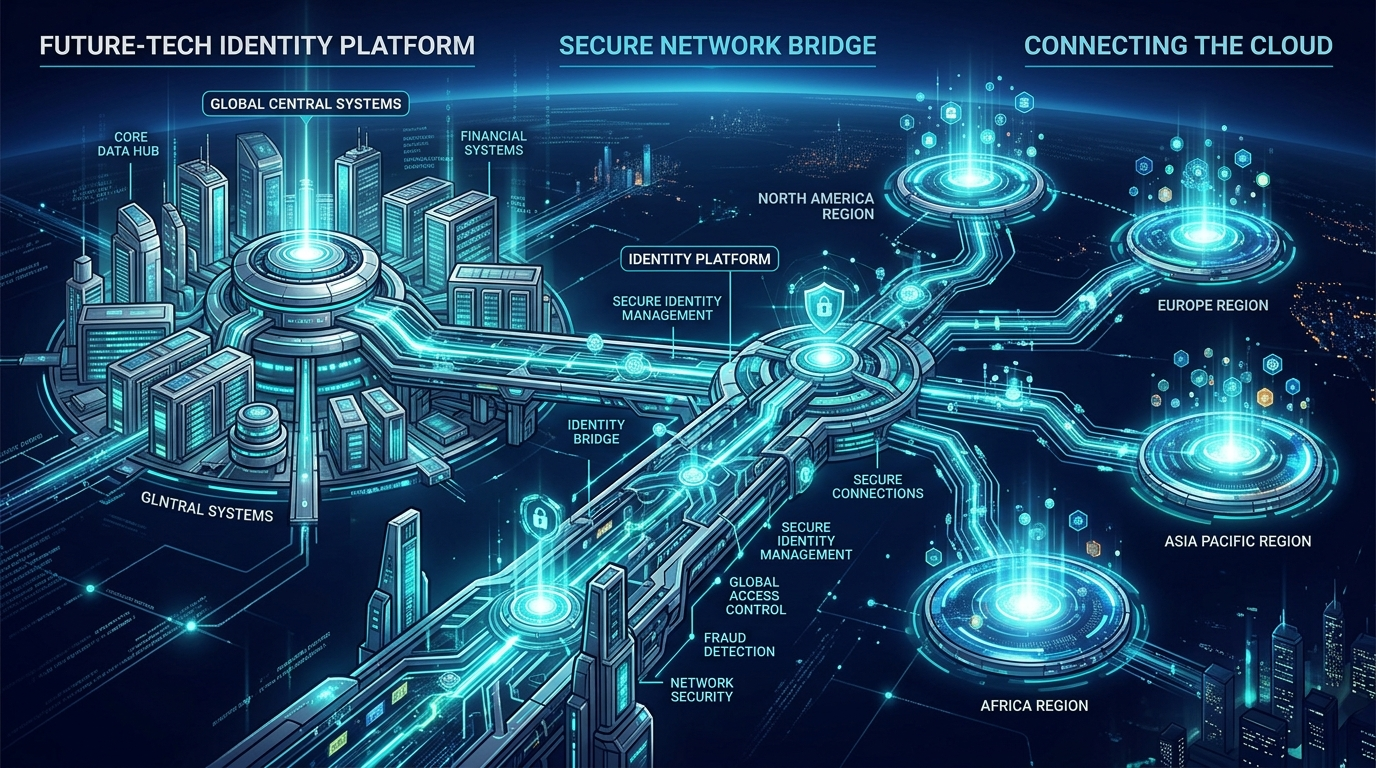
Behind every enterprise Google Cloud Platform (GCP) workload lies an unseen, hyper-critical foundational layer: Identity. Whether it is a serverless function fetching secrets, an automated machine learning job querying BigQuery, or a Kubernetes pod interacting with Cloud Storage, Service Accounts and machine identities form the nervous system of modern cloud computing.
For over a decade, however, these cloud-native identities shared an architectural umbilical cord with Google’s consumer-facing account infrastructure. Project Aether was the ambitious engineering initiative that severed this legacy bond—decoupling cloud identity from global consumer infrastructure and establishing Cloud Gaia as a high-velocity, regionally isolated, 99.999% available identity powerhouse.
Project Aether Mission: Move the authoritative Source of Truth (SoT) for all GCP-native identity accounts—including IAM Service Accounts, Identity Namespace (IDNS) accounts, Console Service Robots (CSRs), and system robots—out of legacy Core Gaia and into Cloud Gaia native ownership, eliminating all global single points of failure.
The Genesis: Why Identity Needed Decoupling
When GCP launched over a decade ago, building a brand-new identity authentication backend from scratch would have slowed cloud platform adoption. Instead, GCP leveraged Core Gaia—Google’s consumer identity service managing @gmail.com accounts, Workspace domains, and internal developer identities (@prod.google.com).
While Core Gaia offered massive scale, its architecture was optimized for human users:
- Global Failure Domain: Core Gaia’s central database topology meant that a severe global outage or latency spike in the core storage layer could propagate worldwide.
- Lack of Regional Isolation: Enterprise cloud customers operate under strict Regional Fault Isolation mandates. A network disruption in
us-central1must never disrupt workloads running ineurope-west1. - Data Residency (DRZ) Compliance: Government and enterprise partners increasingly demand strict sovereignty boundaries where credential encryption metadata and account audit paths stay inside designated geographic borders.
The Dual-Bridge Decoupling Architecture
To achieve identity decoupling without breaking hundreds of thousands of live enterprise apps, Project Aether introduced a dual-bridge hybrid architecture.
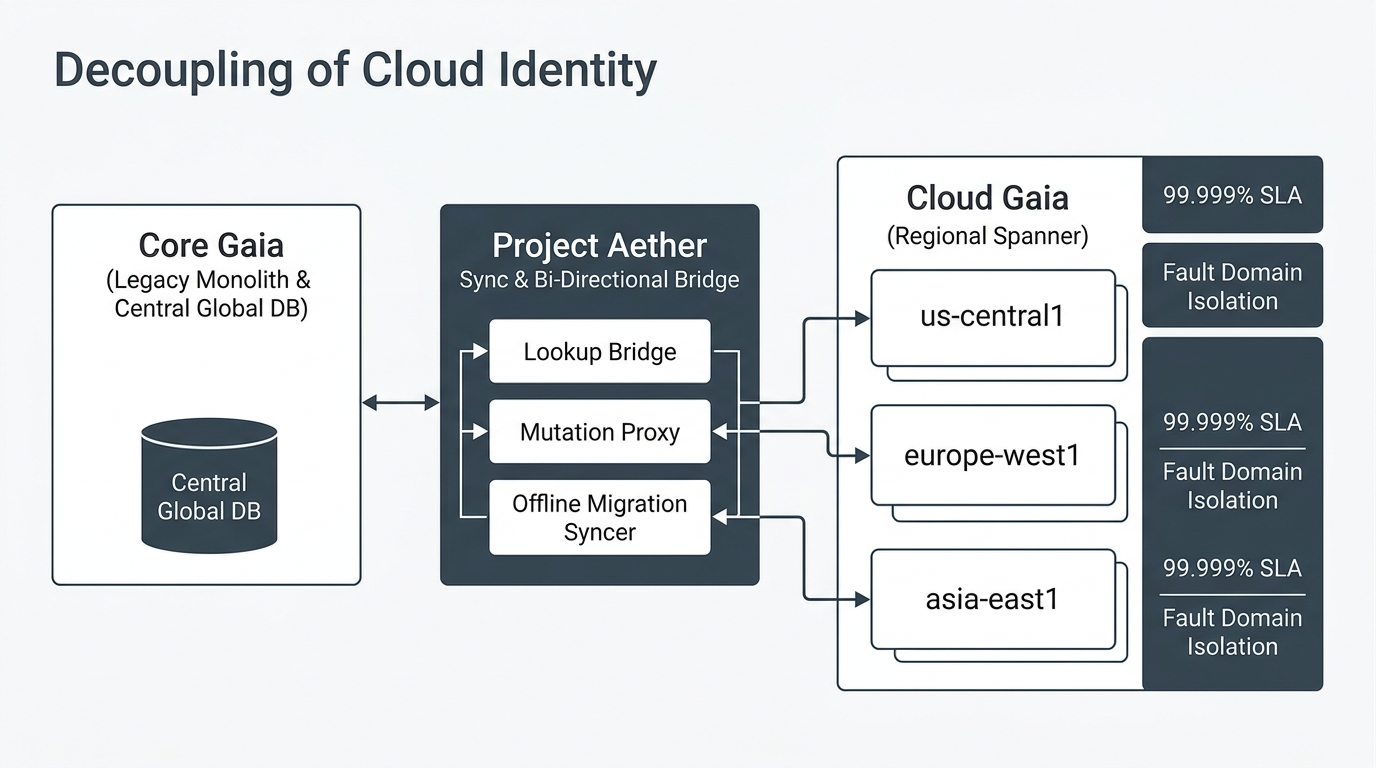
Key Subsystems
| System Component | Role & Functionality | Architecture |
|---|---|---|
| Core Gaia (Legacy) | Continues to serve human users (Gmail, Workspace) and legacy robots. |
Global Monolith & Core DB |
| Aether Lookup Bridge | Intercepts read requests in GaiaBE, checks pre-allocated ID space, and transparently routes lookups to Cloud Gaia with lag-tolerant strong reads. | Distributed RPC Proxy (stubby) |
| Aether Mutation Bridge | Intercepts account creation, key generation, and role mutations (AMS Proxy), dispatching mutations to authoritative Cloud Gaia storage. |
Account Management Service (AMS) |
| Aether Storage Migration Service | Handles continuous batch data pipelines (SQLP/Unipipe), data parity reconciliation, and twice-daily sanity checks. |
Batch Offline Pipeline / Placer |
| Cloud Gaia (Modern) | Global Control Plane + Multi-Region Data Planes with zero cross-regional runtime dependencies. | Multi-Region Cloud Spanner |
Non-Disruptive Live Mutation Interception
sequenceDiagram
    autonumber
    actor Dev as Developer / Terraform
    participant AMS as AMS / AccountApi
    participant Bridge as AetherMutationBridge
    participant CG as Cloud Gaia (Global Spanner)
    participant Core as Core Gaia DB (Legacy)

    Dev->>AMS: Create Service Account Key
    AMS->>AMS: Validate ACLs & Quotas
    AMS->>Bridge: Inspect Account Source of Truth (SoT)
    alt SoT is in Cloud Gaia (Migrated)
        Bridge->>CG: Execute Mutation on Cloud Gaia Spanner
        CG-->>Bridge: Mutation Ack + Event Log
        Bridge-->>AMS: Return New Key Credentials
    else SoT is in Core Gaia (Legacy)
        Bridge->>Core: Mutate Core Gaia Monolith
        Core-->>Bridge: Ack
        Bridge-->>AMS: Return Key
    end
    AMS-->>Dev: Success (200 OK)
Breakthroughs & Real-World Impact
- Elimination of Global Blast Radius: Service accounts running in
europe-west1authenticate against localized Cloud Gaia Spanner instances. - True Data Residency (DRZ): Metadata, service account keypairs, and credential histories stay inside customer-selected geographic boundaries.
- Foundation for Project Hemera: Paved the way for decoupling human workforce authentication via Workforce Identity Federation.
Published as part of the Aether Platform Cloud Architecture series.