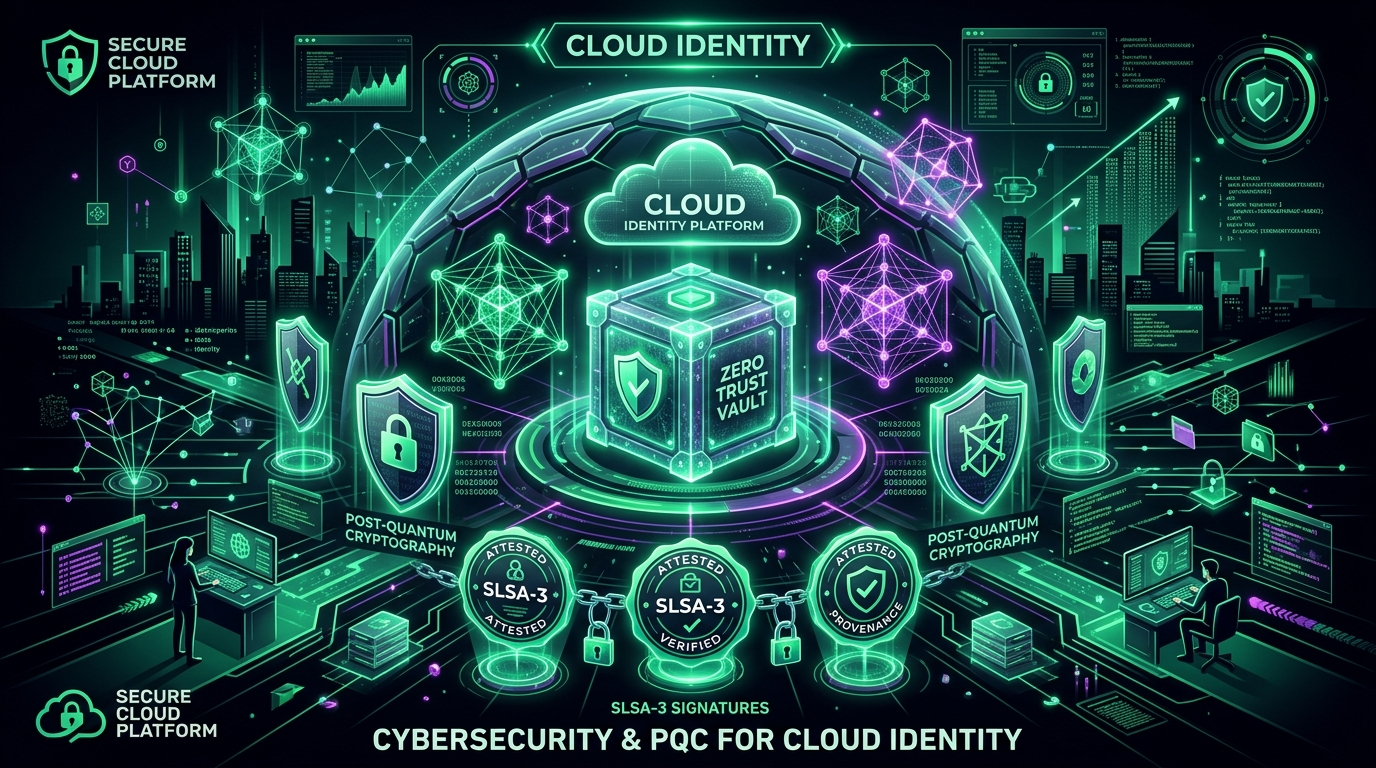
As enterprise autonomous AI engineering agents and microservices scale to manage critical infrastructure across cloud and edge topologies, the foundational assumptions underlying classical cybersecurity are shifting. Among the most looming challenges facing modern identity platforms is the advent of cryptographically relevant quantum computers (CRQCs).
Classical asymmetric encryption algorithms—such as RSA-2048 and Elliptic Curve Cryptography (ECDSA/ECDH)—form the backbone of today’s Service Account private keys, JSON Web Tokens (JWTs), mTLS connections, and container image signatures. A sufficiently powerful quantum computer running Shor’s Algorithm could factor large primes and compute discrete logarithms in polynomial time, collapsing decades of public-key trust.
In the Aether Platform—the distributed cognitive substrate for autonomous engineering and enterprise cloud identity—security is not bolted on as a postscript. This article details how Aether combines NIST Post-Quantum Cryptography (PQC) standards, gVisor application kernel sandboxing, Cosign SLSA-3 supply chain attestations, and zero-trust presenter-bound credentials to harden cloud identity.
The Harvest Now, Decrypt Later (HNDL) Threat: Adversaries actively intercept and store encrypted TLS handshakes, internal service-to-service tokens, and long-lived Service Account keys today. Once a CRQC becomes operational, adversaries can retroactively decrypt recorded traffic.
PQC Architecture in Aether: Hybrid Lattice Cryptography
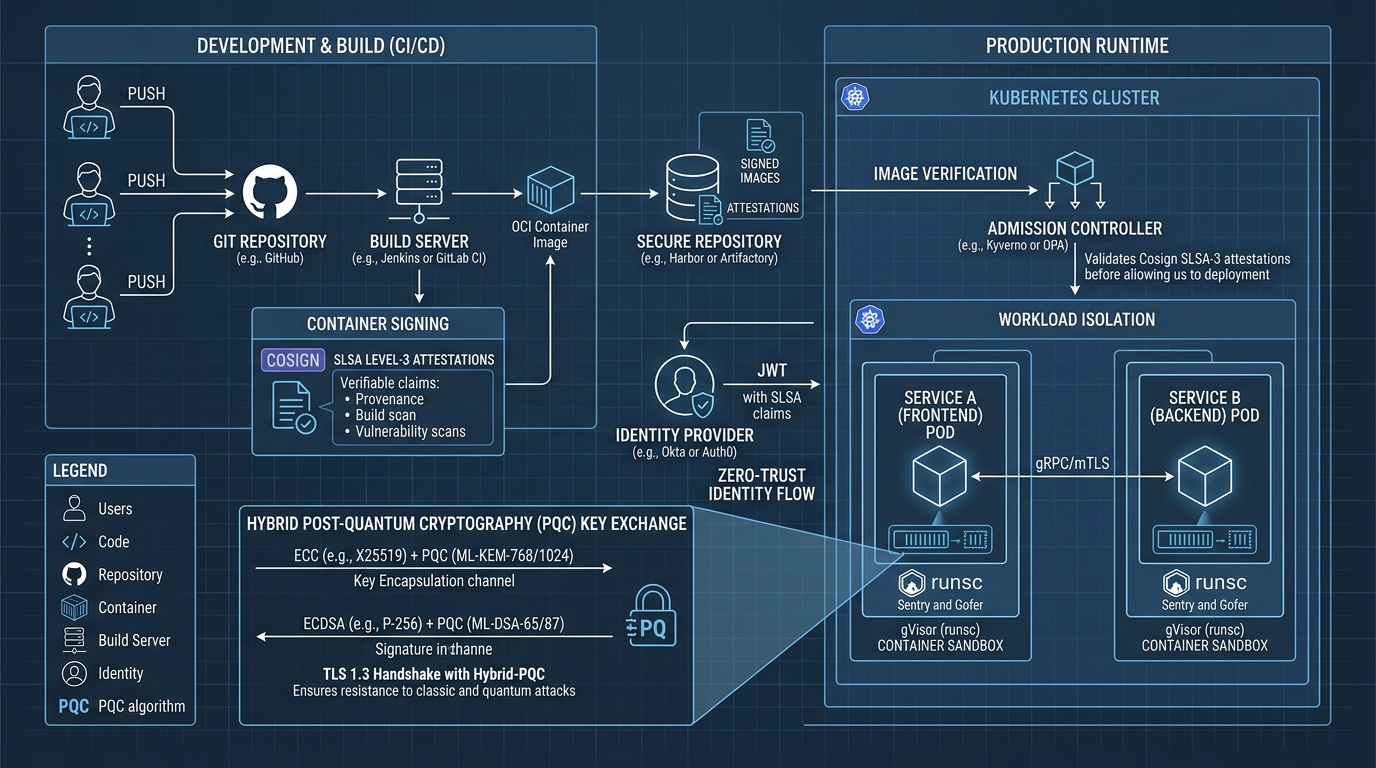
The Aether platform establishes a dual-defense cryptographic paradigm by implementing Hybrid Post-Quantum Cryptography. Rather than immediately dropping classical primitives, Aether layers newly standardized NIST FIPS 203 and FIPS 204 lattice-based post-quantum algorithms alongside proven classical elliptic curve primitives.
Cryptographic Primitive Matrix
| Security Layer | Classical Primitive | Post-Quantum Primitive | NIST Standard | Operational Context |
|---|---|---|---|---|
| Key Encapsulation (KEM) | X25519 / ECDH-P256 |
ML-KEM-768 / 1024 (Kyber) | FIPS 203 | Internal mTLS handshakes, AX Event Log streaming |
| Digital Signatures | ECDSA-P256 / Ed25519 |
ML-DSA-65 / 87 (Dilithium) | FIPS 204 | Service account key certificates, Cosign OCI attestations, SLSA-3 cards |
| Hash Functions | SHA-256 |
SHA-3 / SHAKE-256 | FIPS 202 | Image digest calculation, Merkle tree log commitment |
Zero-Trust Identity & Presenter-Bound Credentials
Cryptographic algorithms alone are insufficient if credentials can be stolen and replayed. Aether mitigates token theft through Presenter-Bound Identity Guarantees:
- Short-Lived Ephemeral Mints: Service Account access tokens minted via Cloud Gaia are scoped to a maximum lifespan of 60 minutes (with defaults of 15 minutes).
- Cryptographic Presenter Binding (LOAS / Ubermint Assertions): Service tokens issued to workloads running inside Aether sandboxes are bound to the underlying Low Overhead Authentication Service (LOAS) attestation certificate of the presenting pod.
- SPIFFE/SVID mTLS Mesh: Autonomous agents receive cryptographically rotated X.509 certificates derived from internal Cloud Gaia SPIFFE authorities.
Workload Isolation: gVisor runsc & eBPF Security Hooks
When multi-tenant AI engineering agents (Polecat Actors) execute code or run builds, protecting the underlying host OS is paramount. Traditional OCI containers share the host Linux kernel surface—leaving system calls exposed to container escapes.
- gVisor
runscSandbox Boundary: Every agent task executes inside Google’s open-sourcegVisorsandbox, emulating syscalls in user space and dropping the host attack exposure by >90%. - eBPF Real-Time Enforcers: Extended Berkeley Packet Filters (eBPF) inspect socket connections and process invocations at runtime, terminating unauthorized outbound network attempts immediately.
Supply Chain Provenance: SLSA-3 & Cosign Rekor Cards
Every container pushed to the internal image registry produces a verifiable CycloneDX v1.5 JSON SBOM card and a Cosign SLSA-3 transparency log card (#1849204). Admissions controllers validate signatures and Trivy zero-critical vulnerability audits before scheduling pods onto edge nodes.
Authored by the Aether Cyber-Security & Cryptography Group.