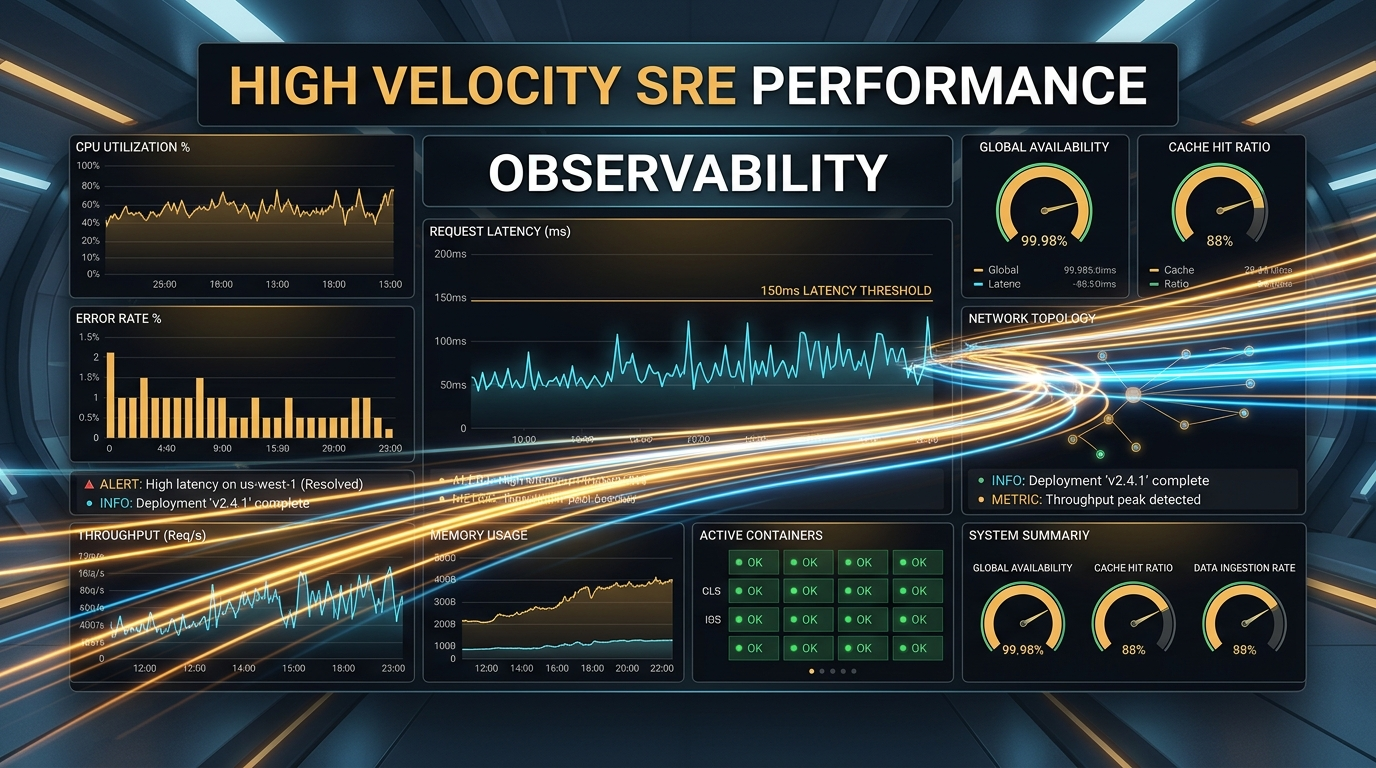
When building platforms capable of running autonomous AI engineering agents, classic Site Reliability Engineering (SRE) paradigms face a breaking point. Unlike static web services where request-response lifecycles terminate in tens of milliseconds, autonomous agent trajectories run multi-turn feedback loops, edit codebases, run shell commands, and interact with live cloud infrastructure over prolonged execution sessions.
If an underlying worker pod crashes, a network node drops, or a cloud dependency throttles halfway through an agent’s multi-step refactoring task, traditional recovery methods involve restarting from scratch—losing computational state, context history, and engineering velocity.
This article explores the SRE Genesis and Performance Engineering of the Aether Platform: how the team achieved an unprecedented <30-second Tekton container build SLA, engineered <150ms instant session state-teleport recovery, built a Google AX single-writer append-only event durability log, and institutionalized closed-loop observability with OpenTelemetry and Gemini 3.5 Pro ADK SRE streams.
10x SLA Velocity Leap: Dropping container build SLAs from 20 minutes down to <30 seconds transformed deployment pipelines from slow background jobs into interactive surfaces for autonomous AI engineering swarms.
The Build Velocity Bottleneck: From 20 Minutes to <30 Seconds
Before autonomous engineering agents can remediate incidents or push pull requests, the platform’s delivery pipeline must be frictionless. In early architecture iterations, compiling heavy multi-platform UI applications pushed container build times to 20–25 minutes per release.
The Aether engineering group radically refactored the build stack:
- Replacement of Monolithic Cross-Compilers: Replaced heavy compilation paths with a lightweight 2-Stage Node.js 20 Alpine + Vite React frontend engine and Go-based backends.
- In-Cluster Kaniko Builder: Replaced standard docker-in-docker daemon dependencies with daemonless Kaniko executions running directly inside Kubernetes build pods.
- Local PVC Layer Caching: Attached high-speed NVMe Persistent Volume Claims (
PVC) to cachenode_modules, Go build caches, and Trivy security databases.
┌─────────────────────────────────────────────────────────────────────────────┐
│                      CONTAINER BUILD SLA COMPARISON                         │
│                                                                             │
│  Legacy Stack (Flutter / Heavy CI):                                         │
│  [==================================================] 20 - 25 Minutes       │
│                                                                             │
│  Aether Refactored Stack (Kaniko + Alpine + Vite + PVC Cache):              │
│  [==] < 30 Seconds  (10x Velocity Leap)                                    │
└─────────────────────────────────────────────────────────────────────────────┘
Instant Session Teleport (<150ms) & Google AX Durability Logs
What happens when a node running an active engineering agent dies? In the Aether substrate, session persistence is powered by the Google AX Single-Writer Durability Log.
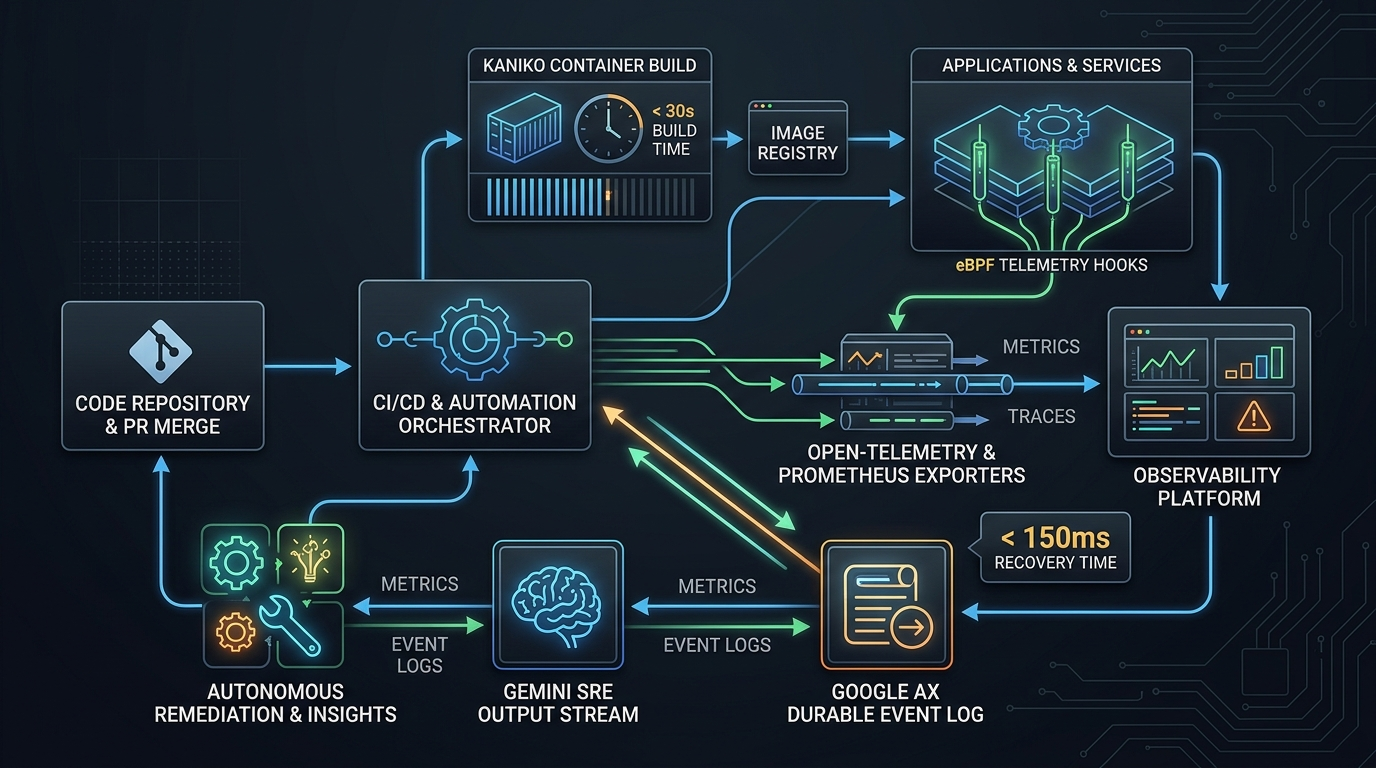
System Architecture of State-Teleport
Rather than letting individual workers maintain volatile local state, Aether models all cognitive actions as an immutable event stream written to a single-writer append-only durability log:
sequenceDiagram
    autonumber
    participant Actor as Polecat Actor (gVisor)
    participant AX as AX Controller (Single-Writer)
    participant Log as Append-Only Durability Log
    participant Sub as Substrate Scheduler / K3s Mesh

    Actor->>AX: Stream Action Trajectory Step N
    AX->>Log: Synchronous Commit & Flushed Index
    Log-->>AX: Ack
    AX-->>Actor: State Checkpoint Verified

    Note over Actor,Sub: Hardware Node Failure / Preemption Event!

    Sub->>Sub: Detect etcd Lease Expiration (Heartbeat Missed)
    Sub->>AX: Request Re-hydration for Workspace ID
    AX->>Log: Read Last Verified State Trajectory (<10ms)
    Sub->>Actor: Spawn New gVisor Sandbox & Teleport Snapshot (<140ms)
    Actor-->>Sub: Resume Trajectory at Step N+1 (Zero Loss)
Key Recovery Metrics
- Heartbeat Timeout:
etcdnode lease TTL set to 2 seconds. - Snapshot Re-hydration Latency: Under 150 milliseconds end-to-end (
< 150ms recovery time). - Zero Dual-Write Drift: Single-writer append-only model prevents split-brain corruption.
Closed-Loop SRE Observability: OTel, Prometheus & Gemini ADK
Observability in Aether is built around a tripartite streaming model:
- W3C OpenTelemetry (
OTEL) & Prometheus Exporter: Every HTTP, gRPC, and eBPF event emits W3C trace contexts (traceparent,tracestate), exposing live Prometheus histogram metrics at/metrics. - GUI Action Telemetry (
sreAgentStore): Visual UI clicks and operator actions in the Backstage VDOM cockpit triggersreAgentStore.recordGuiAction(), streaming user actions directly into Prometheus and Grafana dashboards. - Gemini 3.5 Pro ADK SRE Output Stream: Autonomous ADK agents consume trace anomalies and formulate 1-click JSON RCA audit sheets and remediation pull requests.
Multi-Region Failure Isolation
| Operational Domain | Cluster Topology | Blast Radius Control |
|---|---|---|
| Master Control Node | sweetsixty6 (100.92.249.20) |
Isolated master control plane orchestrating Tailscale wireguard mesh. |
| Edge Compute Nodes | K3s Nodes (rpi, rpj, rpk, raspberry) |
Regional workload execution; node outage triggers automatic sub-150ms pod failover. |
| Hermetic Test Harness | AetherLookupBridgeTestSuite |
Automated synthetic canary probers test data parity and SLA compliance. |
Authored by the Aether Platform SRE & Performance Engineering Group.