If you have spent two decades walking and cycling past the iconic curved facade of the Berlaymont, under the blue European Union flags flying over Rond-Point Schuman, you develop a deep appreciation for moments when technology and public policy move in harmony.
This week, Google announced a major milestone in responsible AI governance: signing the official EU AI Act Code of Practice on Transparency of AI-Generated Content under Article 50. As a Google software engineer living in Brussels who has witnessed the evolution of European digital policy over the last twenty years, I view this signature not merely as a regulatory milestone, but as a resounding pledge to protect every user across the digital ecosystem.
A Shared Vision for Responsible AI: Proactive Industry Leadership (SynthID & C2PA) $+$ Collaborative European Governance (EU AI Office) $=$ Default Safety and Transparency for Every Citizen.
1. Protecting Every User: What Article 50 Transparency Achieves
At the core of the EU AI Act’s Article 50 is a vital principle: citizens have a fundamental right to trust what they see and hear online. In an era of rapid generative AI innovation, providing clear, machine-readable provenance for synthetic media ensures that creativity flourishes without compromising digital authenticity.
By signing the voluntary Code of Practice facilitated by the European AI Office, Google is reinforcing its long-standing commitment to Safety by Design:
- Imperceptible Latent Watermarking: Deploying Google DeepMind’s breakthrough SynthID technology, which embeds invisible, tamper-resistant watermarks into AI-generated images, audio, video, and text without diminishing quality.
- Open Content Credentials (C2PA): Championing open industry standards through the Coalition for Content Authenticity and Provenance (C2PA), enabling cross-platform verification across browsers, cameras, and media platforms.
- Empowering Citizens and Media: Equipping journalists, researchers, election monitors, and everyday users with reliable tools to verify content provenance effortlessly.
┌─────────────────────────────────────────────────────────────────────────────┐
│                 GOOGLE RESPONSIBLE AI TRANSPARENCY ECOSYSTEM                │
│                                                                             │
│  [ Generative AI Model ] ──► [ SynthID & C2PA Metadata ] ──► [ Safe User ]  │
│  (Gemini / Veo / Imagen)     (Cryptographic Watermark)       (Protected)    │
└─────────────────────────────────────────────────────────────────────────────┘
2. A 20-Year Brussels Journey: From Principles to Default Protections
Looking back at the trajectory of European tech policy over the past two decades—from early discussions on e-commerce to GDPR, NIS2, and now the EU AI Act—one clear lesson emerges: technology is at its best when it serves human dignity.

Google’s decision to sign the Code of Practice reflects a proactive mindset. Rather than waiting for mandatory enforcement deadlines, Google has consistently led the industry by developing safety tools long before regulations took shape. From pioneering SynthID in DeepMind labs to open-sourcing safety evaluation datasets, Google has demonstrated that user safety and cutting-edge innovation go hand in hand.
In our daily work across Google’s engineering platforms, this translates to default safety mechanisms integrated across product layers—ensuring that every consumer, business, and public sector partner benefits from enterprise-grade protection.
3. End-to-End Transparency Architecture
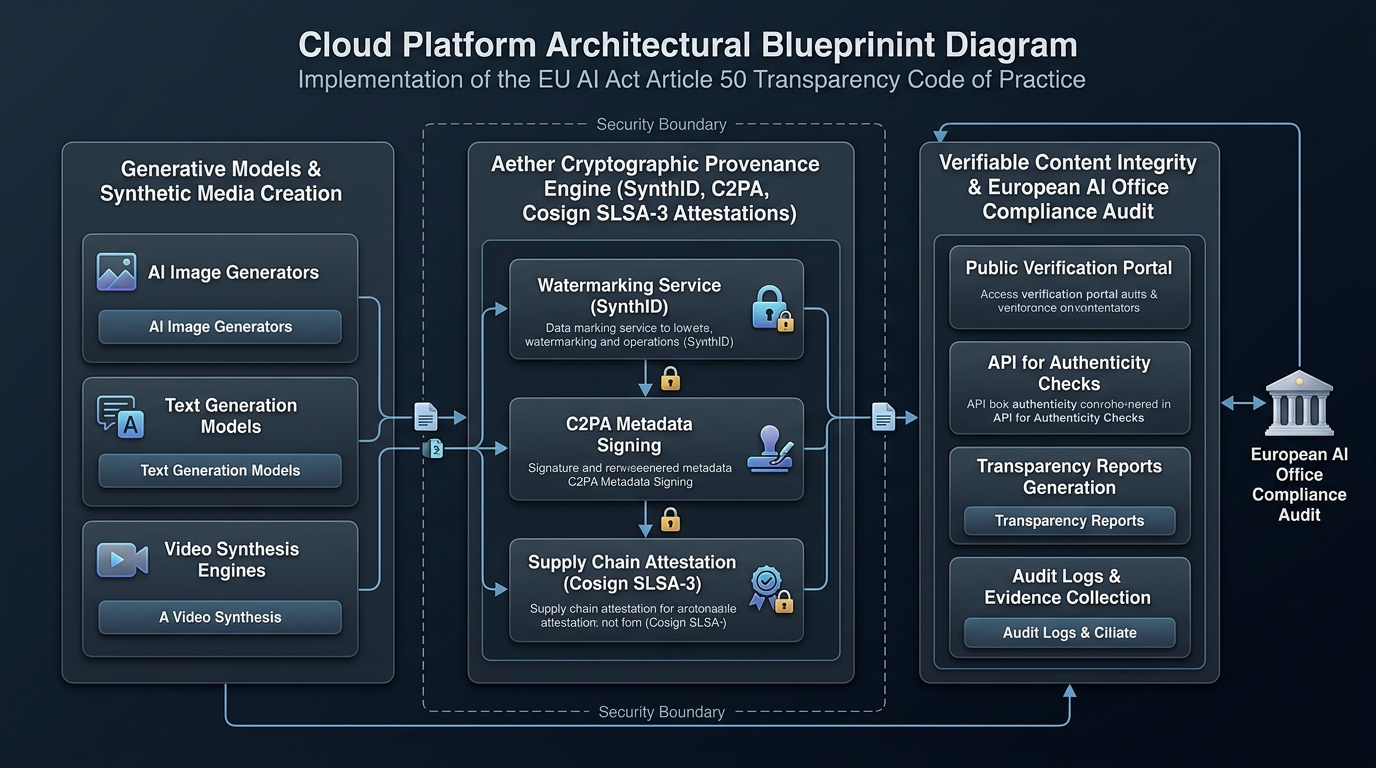
To see how these protections operate together in cloud systems, the architectural blueprint below illustrates the full journey from model output to public auditability:
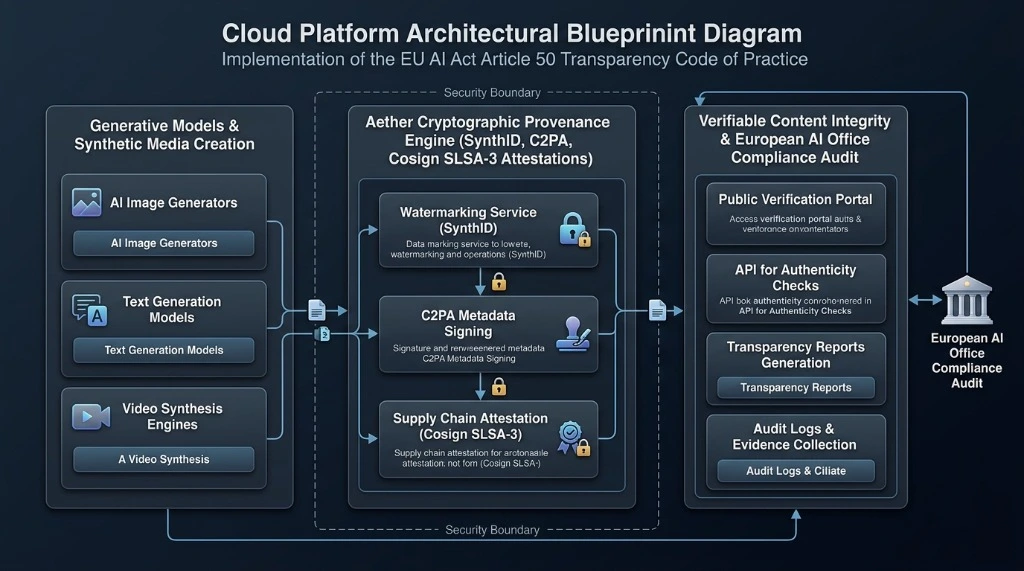
Figure 1: Implementation blueprint showing Generative Models feeding into the Cryptographic Provenance Engine (SynthID, C2PA, Cosign SLSA-3) and connecting to the European AI Office Compliance Audit ecosystem.
As shown in the blueprint:
- Generative Media Creation: Image generators, text generation models, and video synthesis engines ingest content requests inside secure boundaries.
- Cryptographic Provenance Engine: Watermarking services (SynthID) tag latent spaces, C2PA signing adds open content credentials, and supply chain attestations (Cosign SLSA-3) verify build integrity.
- Verifiable Content Integrity: Public verification portals, authenticity APIs, transparency reports, and evidence collection logs feed directly into European AI Office compliance audits.
4. Looking Ahead: Building a Safer AI Future Together
As I pause outside the European Commission headquarters on a crisp Brussels afternoon, I am genuinely optimistic about the path forward.
Google’s endorsement of the EU AI Act Code of Practice sets a positive benchmark for the entire tech industry. By combining world-class AI research with open provenance standards and proactive regulatory cooperation, Google is showing how technology leaders can build an AI-powered future that is innovative, transparent, and safe for everyone.
Authored by a Google engineer based in Brussels, reflecting on European public policy and AI safety.