1. From Rue de la Loi to the Diffusion Switchboard: Convening a Plenary Session for a Boolean
It is Saturday morning in Brussels, the thirty-first of October, and the autumn rain is already polishing the cobblestones between Parc du Cinquantenaire and Rond-Point Schuman.
In the European Quarter, there is a time-honored bureaucratic art form known as convening a twenty-seven-delegation working party, three juristes-linguistes, and a late-night interinstitutional trilogue simply to decide whether a paragraph requires a semicolon or a full stop. We laugh at Rue de la Loi when a binary administrative check takes four hours of sequential deliberation. Yet every single morning across thousands of production cloud clusters, AI platform teams commit the exact same sin in silicon: they wake up a frontier autoregressive Large Language Model and force it to generate sixty sequential JSON tokens just to answer a Yes/No question.
Over this morning’s espresso doppio—pulled at a strict 9 bars while a yellow STIB tram rattles past the window—let’s open the atelier notebook and examine why 80% of your “LLM calls” shouldn’t be autoregressive generation at all, how dgem (Decision Diffusion Gemma) turns a discrete diffusion canvas into a 55–61.8 ms cognitive switchboard, and how we wire it into three high-velocity production workflows: Support Ticket Triage, Live SRE Evaluation & 202-Tool Routing, and Sub-60ms Speaker Detection for Diarization.
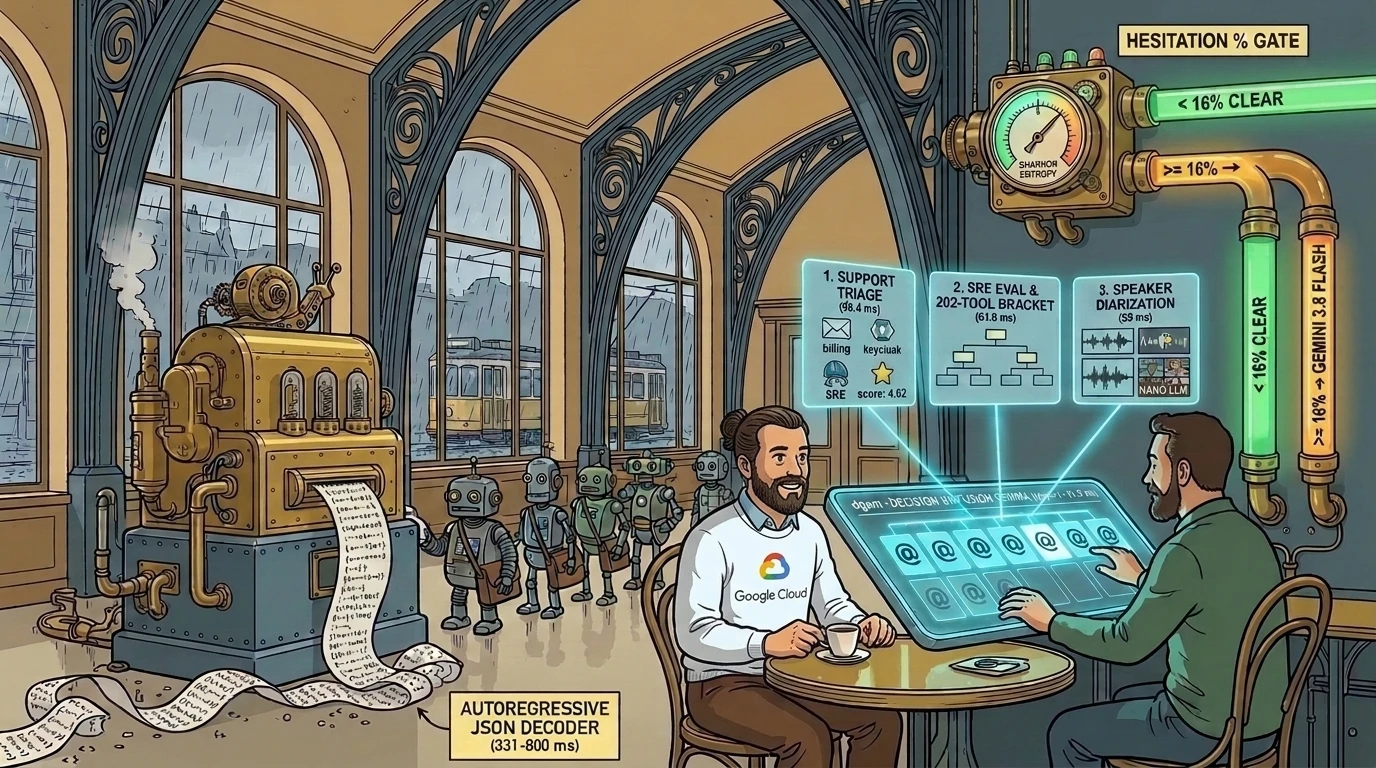 Saturday morning in the Brussels switchboard rotunda: on the left, the old Autoregressive JSON Teletype (
331–800 ms) cranking out { "urgent": "yes" } one character at a time under a mechanical snail; in the center and right, @jpaquay in his Google Cloud crewneck over an espresso doppio alongside our dgem 1-step Bidirectional Diffusion Canvas (steps=1, 61.8 ms for 10 questions), routing Support Triage, SRE Evals, and Speaker Diarization with a Shannon Entropy (“Hesitation %”) gate to Gemini 3.8 Flash.
The Autoregressive JSON Tax (331–800 ms for a Point Estimate)
Open the distributed OpenTelemetry trace of any production AI system in late 2026. Eight out of ten model invocations are not open-ended prose synthesis or code generation. They are closed-set “System One” decisions:
- Support Triage: Is this customer ticket time-critical (
yes/no), may the agent auto-refund the duplicate charge (yes/no), which queue owns it (Billing,Keycloak SSO,SRE,Legal), and what is its1..5severity? - SRE Incident & Agent Eval: Did the remediation agent’s database mutation actually clear the SLO burn (
yes/no), is the blast radius contained (yes/no), and which of our202internal MCP runbook tools should execute next? - Real-Time Speaker Diarization: Did a true speaker turn boundary just occur (
yes/no), which meeting participant is speaking (A..Z), is it a backchannel overlap (yes/no), and which tile in the 3x3 video grid is the active speaker?
When you send those questions to a standard autoregressive LLM with constrained JSON decoding (response_schema), you pay three compounding engineering penalties:
- Sequential Memory-Bandwidth Cost: To emit
{"urgent": "yes", "team": "keycloak_iam", "priority": 5, ...}, an autoregressive decoder must run a sequential, memory-bandwidth-bound forward pass for every brace, quote, key character, colon, comma, and value token—turning a single classification pass into 40 to 150 sequential steps (300–800 ms) that return only a single point estimate. - Linear Multi-Question Scaling (
O(M)): If you evaluate each policy or rubric check in its own prompt to avoid cross-question contamination, latency and GPU compute scale linearly with the number of questionsM. - Overconfident, Order-Biased Logprobs: Raw causal token logprobs suffer from notorious first-option bias (
option Aoryes) and poor calibration—the model equivalent of a confident rapporteur who hasn’t read Annex III. Thresholding on"confidence > 0.85"either escalates everything or lets silent hallucinations slip through.
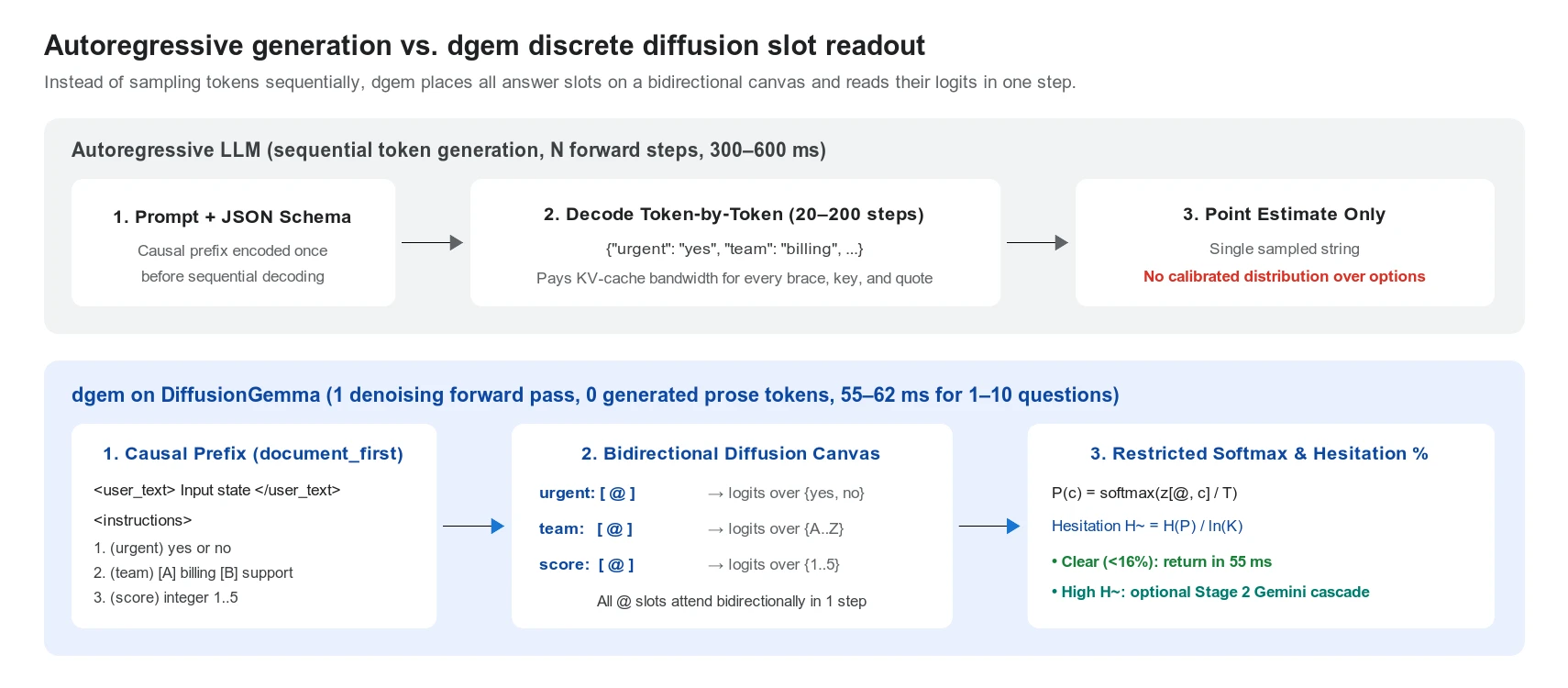 Autoregressive LLMs decode JSON syntax sequentially across 20–200 forward steps (
300–600 ms) and return a single sampled string. dgem places all @ answer slots on a bidirectional diffusion canvas and extracts a calibrated probability distribution over every question in a single forward pass (steps=1, 55–62 ms).
2. How dgem Works: One Bidirectional Diffusion Pass, Zero Prose Tokens, Zero Fine-Tuning
dgem (Decision Diffusion Gemma) (github.com/GoogleCloudPlatform/dgem, created by Hussain Chinoy) is an open-source, zero-shot, policy-as-template decision system built on stock, unmodified DiffusionGemma (google/diffusiongemma-26B-A4B-it)—a discrete block-diffusion Mixture-of-Experts (MoE) model with 25.8B total parameters and ~3.8B active parameters per token, served in NVFP4 quantization on vLLM (DIFFUSION_CANVAS_ROWS=128, steps=1, think=0).
Instead of modifying model weights, dgem changes how the model is prompted and read across four architectural mechanisms:
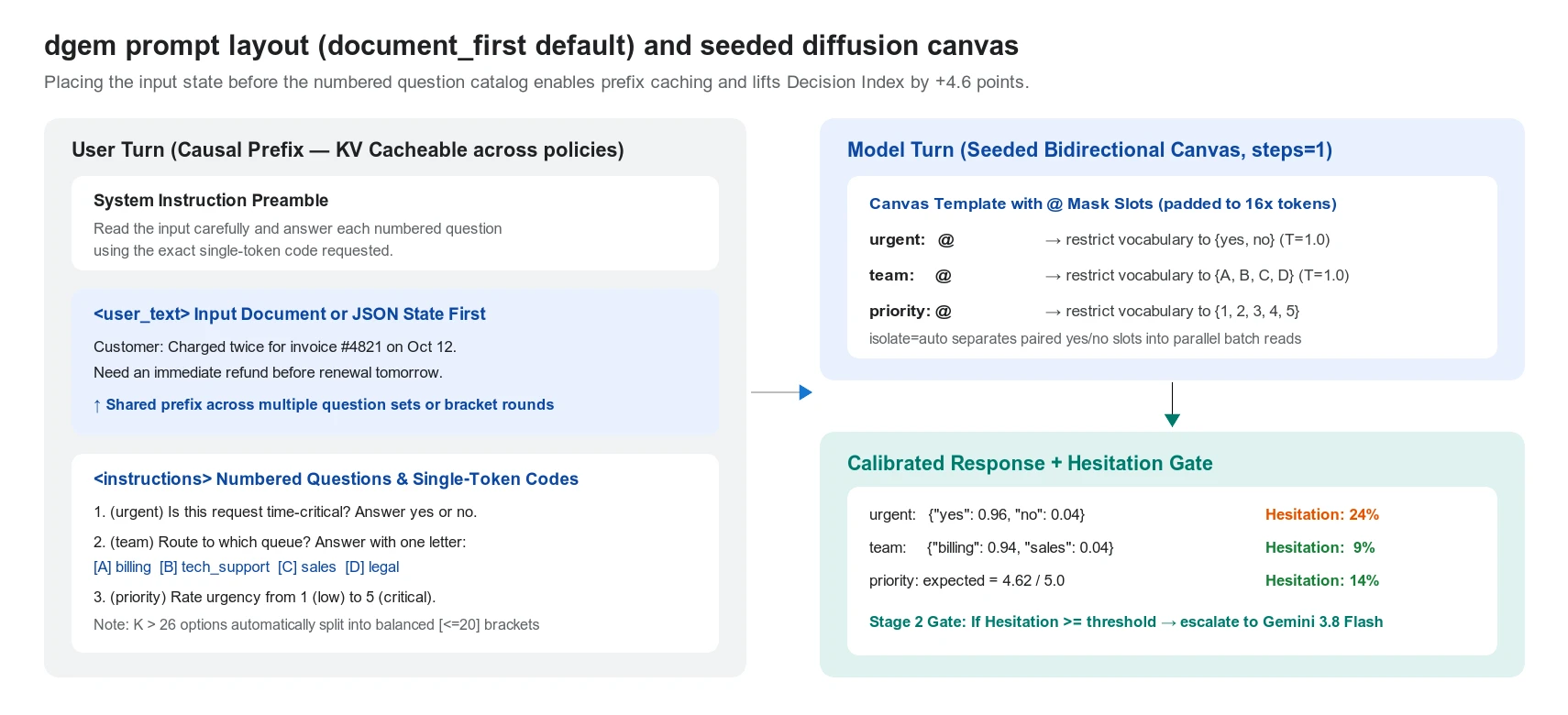 The
document_first prompt layout and seeded diffusion canvas: placing <user_text> before <instructions> allows vLLM’s prefix cache to reuse the encoded document state across multiple policies or tournament rounds, lifting Decision Index 0.2.1 by +4.57 points.
I. The document_first Causal Prefix (+4.57 pts on Decision Index)
In dgem, the user turn places the input state (<user_text>: a support ticket, SRE incident state JSON, meeting transcript window, or base64 image) before the numbered question catalog (<instructions>). This allows vLLM’s prefix cache to encode your document state once and reuse the KV cache across multiple policy templates or tournament rounds—lifting the 38-benchmark Decision Index 0.2.1 score from 40.77 to 45.73 (+13.49 points ahead of naive vLLM structured readout on the exact same weights).
II. Restricted Single-Token Readout & Continuous Expected Scores
The model turn is pre-seeded with a structured canvas containing one @ (<|mask|>) slot per question (urgent: @\nteam: @\npriority: @). In a single denoising forward pass (steps=1), all @ slots attend bidirectionally to one another and to the causal prefix. At each slot m, dgem extracts the raw vocabulary logits z_{m, c} exclusively over that question’s valid single-token code set C_m ({"yes", "no"} for boolean/noul/check; {"A".."Z"} for choice/select; {"1".."9"} for score/rate):
P_m(c) = exp(z_{m, c} / T_m) / Σ_{j ∈ C_m} exp(z_{m, j} / T_m), for c ∈ C_m
For integer rubric questions (score / rate), because dgem has the full probability distribution over levels v ∈ {1, ..., K}, it computes the continuous expected score E[V] = Σ_{v=1..K} v · P_m(v)—capturing subtle severity gradations (e.g., 4.62 / 5.0) that hard argmax integer outputs throw away.
III. Invariant Decision Calibration (isolate: auto & 2-Round Bracket Tournaments)
How do you make zero-shot probabilities trustworthy without training a single weight?
isolate: autoEliminates Yes/No Polarity Contagion (+36.9 pts): When multiple pairedboolean/noulquestions sit on the same canvas row, cross-slot attention can cause confirmation bleed (if four gates areno, the fifth is pulled towardno).dgem’sisolate: autoautomatically gives paired yes/no questions separate parallel canvas reads inside the same GPU micro-batch, liftinggate_mixed_noulaccuracy from59.5%to96.4%–97.7%(ECE0.015–0.028).- Automatic 2-Round Bracket Tournament (
27 <= K <= 255Options): Because single-token capital lettersA..Zcover 26 options in one pass, anychoiceorselectquestion with 27 to 255 options automatically partitions candidates intoB = ⌈K / 20⌉balanced Round-1 pools evaluated in one batched pass, advances the top 2 finalists per pool into a Final canvas (<= 24options), and fuses the probabilities to sum to1.0. This lifts 151-intentCLINC150+OOSaccuracy from43.9%to80.9%and hits87.9%Top-1 /95.0%Recall@7 on the 202-toolworkspace-tools-202benchmark.
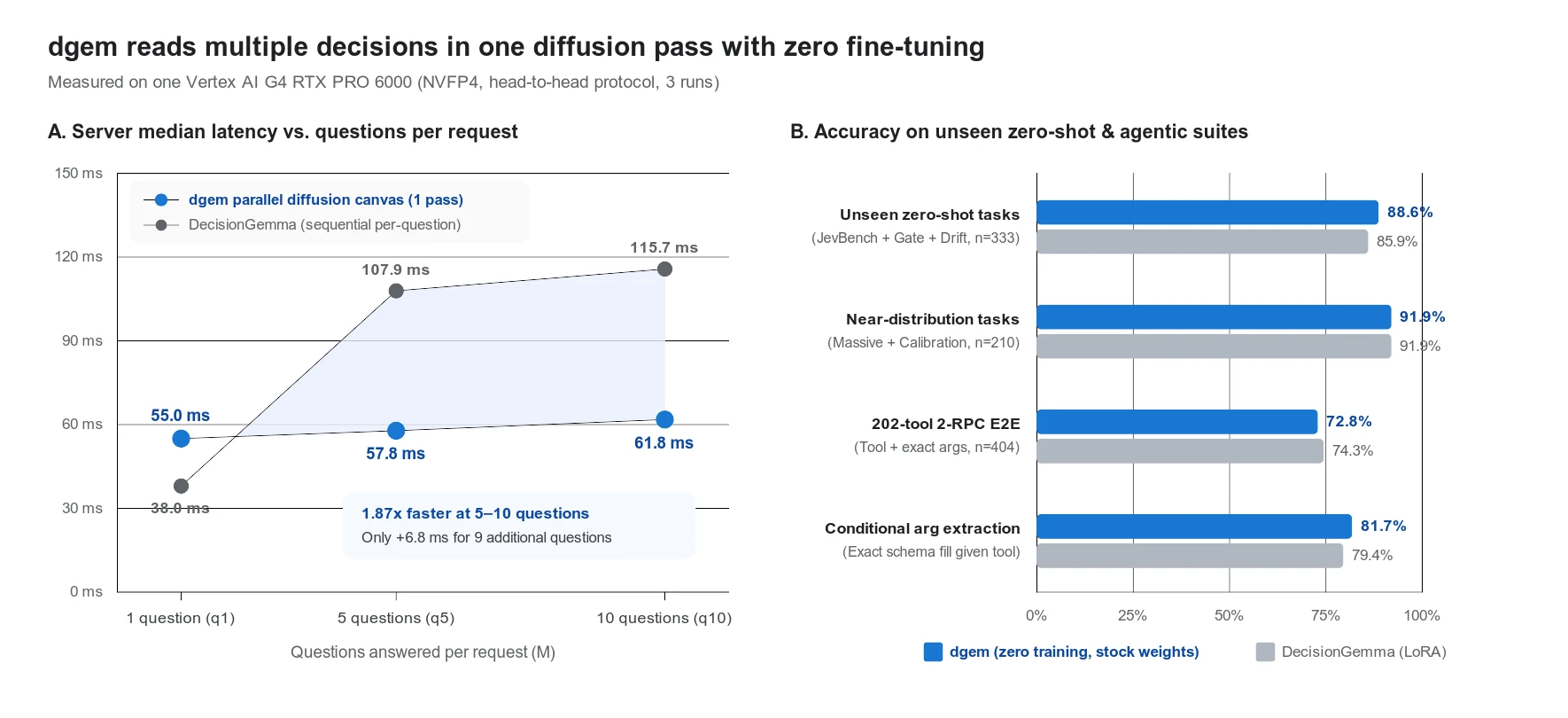 Left: Median server latency on one Vertex AI G4 RTX PRO 6000 across 1, 5, and 10 questions per request (
55.0 ms → 61.8 ms, adding only +0.76 ms per extra question). Right: Zero-shot accuracy on unseen suites (88.6%), near-distribution tasks (91.9%), and 202-tool argument extraction (81.7%).
IV. Hesitation % (H̃) & the Stage 2 Gemini 3.8 Flash Cascade
For every slot, dgem computes Shannon entropy H(P_m) in nats and normalizes it by the uniform-distribution ceiling ln(K):
H̃(P_m) = - [ Σ_{c ∈ C_m} P_m(c) · ln P_m(c) ] / ln(K) ∈ [0%, 100%]
Because Hesitation % (H̃) is normalized by ln(K), a single threshold (escalate_threshold: 0.16) works uniformly across 2-option binary gates, 5-level rubrics, and 26-way routers:
- Clear (
Hesitation < 16%—59.6%of JevBench v1.4): Empirical single-pass accuracy is92.3%. Act immediately in~55–62 ms. - Somewhat Unsure (
16%–50%—19.3%of requests): Empirical accuracy is76.1%. - Very Unsure (
> 50%—21.1%of requests): Empirical accuracy drops to55.5%. - Stage 2 Cascade (
escalate_threshold: 0.16): Uncertain slots are forwarded along withdgem’s Pass-1 distribution as a soft prior (stage2_prior: soft) togemini-3.8-flashon Vertex AI—liftingcalib_systemoneaccuracy from86.7%to98.0%(49/50) while saving66%of frontier LLM calls.
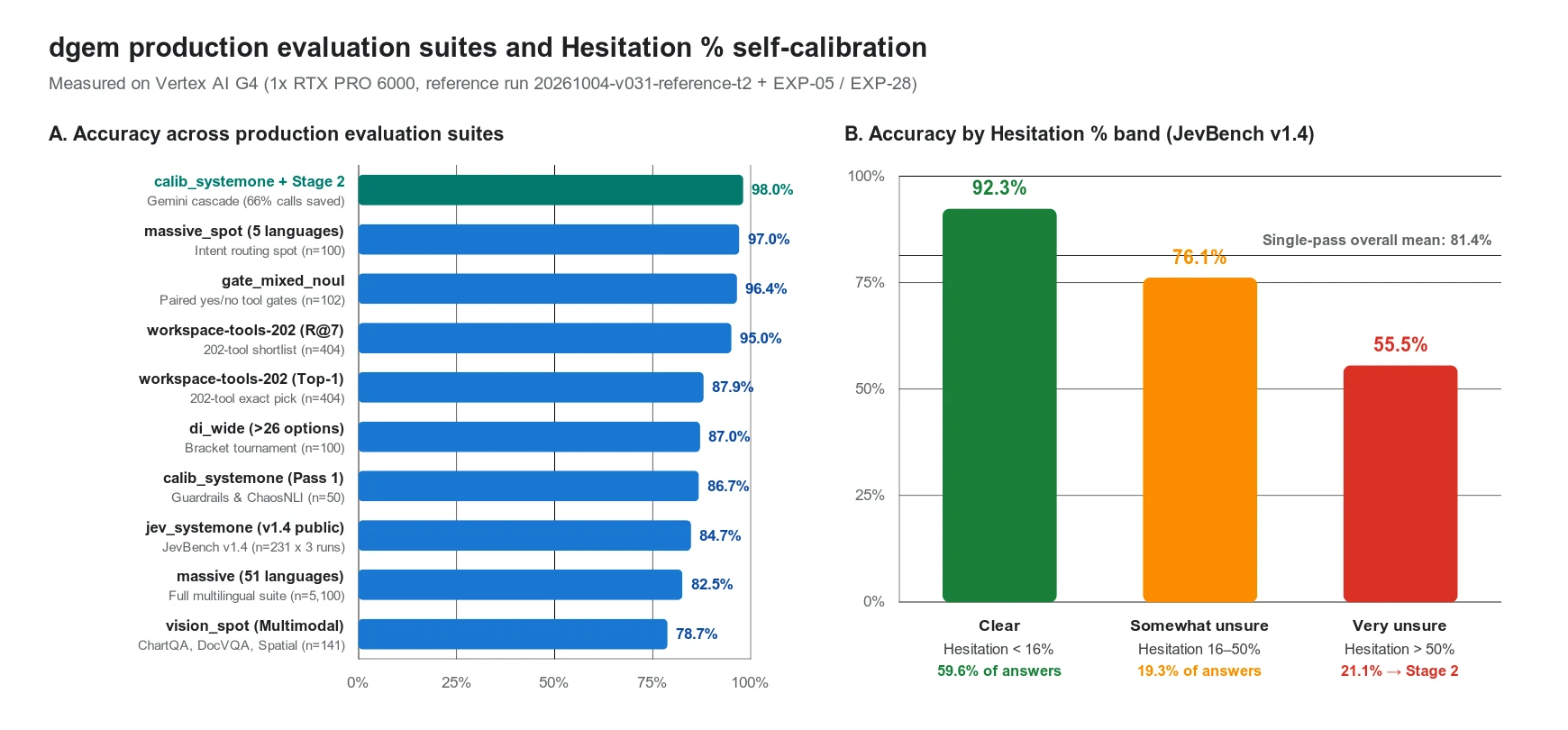 Left:
dgem accuracy across 10 production evaluation suites, topped by 98.0% on calib_systemone with Stage 2 Gemini cascade. Right: Empirical accuracy on JevBench v1.4 stratified by dgem’s own Hesitation % bands (92.3% on Clear answers vs. 55.5% on Very Unsure answers).
flowchart TB
    subgraph IN["1. POLICY-AS-TEMPLATE COMPILER (dgem Gateway / MCP / CLI)"]
        direction LR
        DOC["Input State (user_text / JSON / Image)<br/>• Support Ticket + Keycloak OIDC Error<br/>• SRE Prometheus + Cloud Audit Diff<br/>• ASR + Prosody Window / 3x3 Video Frame"]
        TMPL["Declarative .json.tmpl Policy<br/>• layout: document_first (+4.57 DI pts)<br/>• isolate: auto (+36.9 pts on mixed noul)<br/>• 2-Round Bracket (27..255 options)"]
        DOC --> TMPL
    end

    subgraph DIFF["2. STAGE 1: 1-STEP BIDIRECTIONAL DIFFUSION READOUT (55.0 - 61.8 ms p50)"]
        direction TB
        CANVAS["google/diffusiongemma-26B-A4B-it (NVFP4 on 1x RTX PRO 6000)<br/>• Seeded @ Mask Slots: urgent: @ | refund_auto_approve: @ | team: @ | priority: @<br/>• steps=1 | think=0 | 0 Prose Tokens Generated (+0.76 ms per extra question)"]
        CALIB["Restricted Logit Softmax & Normalized Shannon Entropy<br/>• P_m(c) = softmax(z_m,c / T_m) over valid option codes C_m<br/>• Continuous Expected Score E[V] = sum(v * P_m(v))<br/>• Hesitation % = H(P_m) / ln(K) in [0%, 100%]"]
        CANVAS --> CALIB
    end

    subgraph GATE["3. SHANNON ENTROPY ('HESITATION %') CASCADE GATE"]
        direction LR
        CLEAR["PASS-1 CLEAR (Hesitation < 16%)<br/>• 60–66% of Production Slots<br/>• 92.3% Empirical Single-Pass Accuracy<br/>• Immediate Action in 55–61.8 ms"]
        STAGE2["STAGE 2 CASCADE (Hesitation >= 16%)<br/>• Vertex AI gemini-3.8-flash w/ Soft Prior<br/>• Escalates ONLY Uncertain Slot(s)<br/>• Lifts calib_systemone to 98.0% (66% Calls Saved)"]
    end

    IN --> DIFF
    CALIB -->|"H_norm < 0.16"| CLEAR
    CALIB -->|"H_norm >= 0.16"| STAGE2
3. Three Production System-One Workflows: Support Triage, SRE Eval & Fast Speaker Diarization
Theory is lovely over a first espresso; production YAML and JSON pay the bills over the second. Let’s walk through three real-world engineering workflows where replacing sequential LLM JSON generation with dgem transforms both latency and reliability.
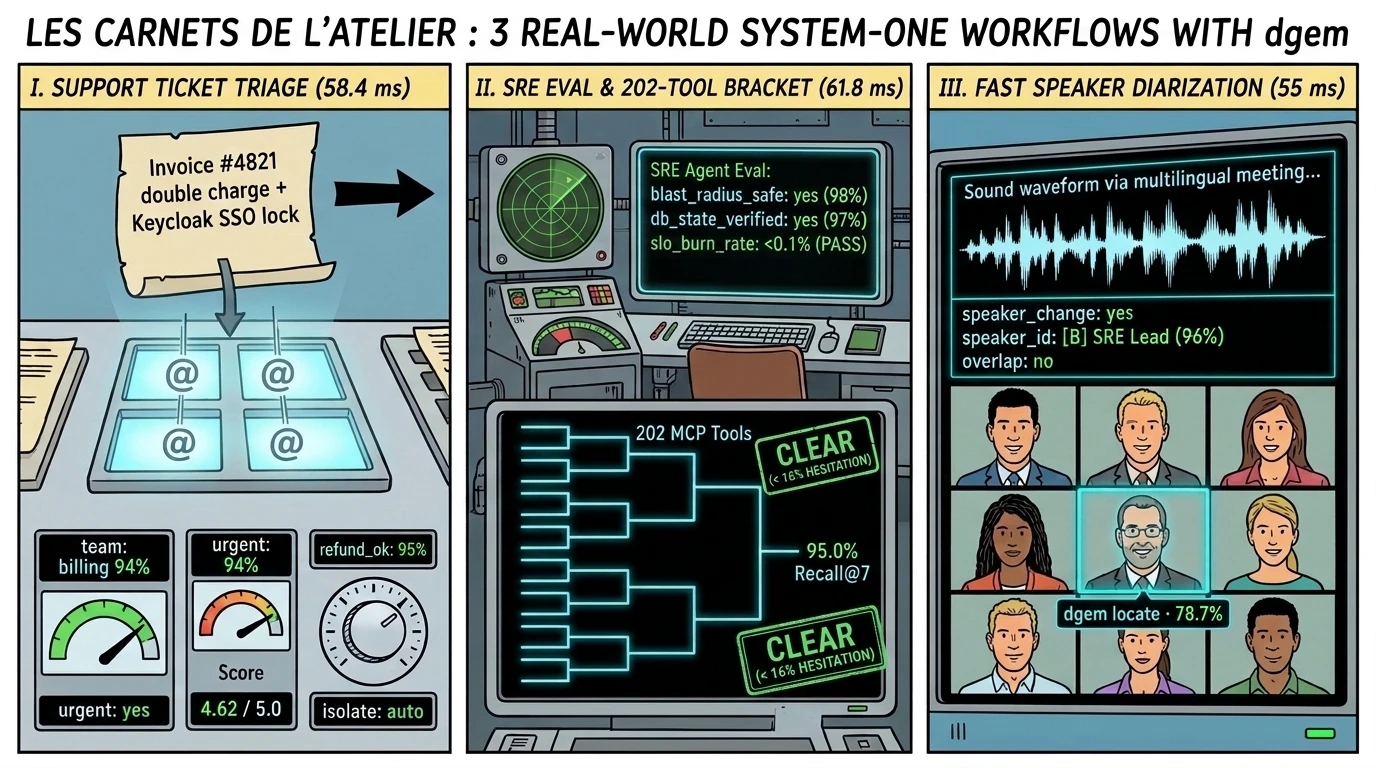 Three production System-One workflows running on a single
dgem diffusion readout engine: (I) Support Ticket Triage (58.4 ms), (II) Live SRE Evaluation & 202-Tool Bracket Routing (61.8 ms), and (III) Sub-60ms Speaker Detection & Multimodal Diarization (55 ms).
sequenceDiagram
    autonumber
    participant App as Ingress / SRE Harness / VAD Bridge
    participant GW as dgem Policy Gateway (document_first)
    participant GPU as DiffusionGemma 26B-A4B (NVFP4, steps=1)
    participant Gem as Stage 2: Gemini 3.8 Flash (Soft Prior)

    rect rgb(235, 248, 255)
    Note over App,Gem: Workflow 1 — Support Ticket Triage (4 Slots + isolate: auto in 58.4 ms)
    App->>GW: POST /api/decide/support_triage (Invoice #4821 double charge + Keycloak OIDC invalid_grant)
    GW->>GPU: Batch Pass-1 Canvas (urgent @, refund_auto_approve @ [isolated], team @, priority @)
    GPU-->>GW: urgent=yes (H=11.4%), refund_ok=yes (H=14.2%), priority=5 E[V]=4.62 (H=15.1%), team=split (H=31.5%)
    GW->>Gem: Escalate ONLY 'team' slot (H=31.5% >= 16%) with Pass-1 soft prior (A:0.51, B:0.44)
    Gem-->>GW: Resolved team=billing (primary) + keycloak_iam sub-task
    GW-->>App: Full 4-Decision Payload + Calibrated Distributions
    end

    rect rgb(240, 253, 244)
    Note over App,Gem: Workflow 2 — Live SRE Eval & 202-Tool Bracket (/v1/systemone in 61.8 ms)
    App->>GW: POST /v1/systemone (Prometheus 5xx=0.0008, Audit Diff, 202 MCP Tools)
    GW->>GPU: Verify 4 SRE Invariants + 2-Round Bracket Tournament (11 Pools -> Top-22 Final)
    GPU-->>GW: end_state_verified=yes (97%), blast_radius=yes (98%), tool=annotate_grafana_slo_burn (87.9% Top-1)
    GW-->>App: Deterministic Pass/Fail Gate + Ranked Tool Shortlist (95.0% Recall@7)
    end

    rect rgb(254, 249, 195)
    Note over App,Gem: Workflow 3 — Sub-60ms Speaker Detection & Multimodal Diarization (55.0 ms)
    App->>GW: POST /api/decide/speaker_diarization_fast (ASR Window + Pitch/Pause Deltas + 3x3 Video Frame)
    GW->>GPU: 1-Step Readout (true_speaker_change @, backchannel_only @, speaker_role @, dgem locate)
    GPU-->>GW: speaker_change=yes (96%), backchannel=no (95%), role=[B] keycloak_iam_lead, tile=row2_col2 (78.7%)
    GW-->>App: Real-Time Diarized Turn Attribution (<60 ms budget)
    end
Use Case 1: Sub-60ms Support Ticket Triage (Routing, Keycloak SSO, Refund Policy Gate & Expected Urgency)
Imagine an enterprise SaaS support gateway in Brussels receiving thousands of tickets an hour: duplicate invoice charges, broken Keycloak OIDC single sign-on (SAML/OIDC realm lockouts after a certificate rotation), webhook timeouts, and GDPR account deletions.
In a traditional agentic setup, triaging a ticket requires either chaining three separate microservice classifiers or asking an LLM to emit a structured JSON object (~420 ms). With dgem, we define a declarative .json.tmpl template (support_triage.json.tmpl) that evaluates four typed decisions in one 58.4 ms wall-clock pass:
urgent(boolean): Does this ticket require immediate escalation?refund_auto_approve(boolean, automatically isolated fromurgentviaisolate: auto): Under our 30-day duplicate-charge policy, may the support agent refund this without manager sign-off?team(choiceacrossA..D): Should this route tobilling,keycloak_iam(Keycloak OIDC/SSO federation),technical_sre, oraccount_legal?priority(score1..5): What is both the discrete winner and the continuous expected urgencyE[V]?
// File: templates/support_triage.json.tmpl
// WHY: Evaluating urgency, refund policy eligibility, queue routing (including Keycloak SSO
// vs. billing), and 1-5 severity on one document_first diffusion canvas resolves in 58.4ms
// with isolate:auto preventing cross-slot yes/no bleed between 'urgent' and 'refund_auto_approve'.
{
  "name": "Support Ticket Triage",
  "category": "routing",
  "layout": "document_first",
  "isolate": "auto",
  "questions": [
    {
      "name": "urgent",
      "type": "boolean",
      "prompt": "Does this ticket require immediate escalation?"
    },
    {
      "name": "refund_auto_approve",
      "type": "boolean",
      "prompt": "Given the policy that duplicate charges within 30 days are auto-refundable under 500 EUR, may an agent refund this without a manager?"
    },
    {
      "name": "team",
      "type": "choice",
      "prompt": "Which engineering or operations team should handle this ticket?",
      "options": {
        "A": "billing: duplicate charges, invoices, VAT receipts, refunds",
        "B": "keycloak_iam: Keycloak OIDC/SAML SSO login failures, realm federation, MFA token locks",
        "C": "technical_sre: API 5xx outages, latency spikes, webhook delivery failures",
        "D": "account_legal: tenant ownership transfer, GDPR erasure, contract cancellation"
      }
    },
    {
      "name": "priority",
      "type": "score",
      "prompt": "Rate urgency from 1 (routine question) to 5 (critical blocker or imminent renewal impact).",
      "scale_min": 1,
      "scale_max": 5
    }
  ]
}
At runtime, our Python ingress gateway calls POST /api/decide/support_triage with escalate_threshold: 0.16:
# WHY: We consume dgem's calibrated probability distribution, expected_score, and
# normalized_entropy (Hesitation %). Clear tickets (<16% hesitation) route in ~58ms;
# multi-issue tickets (e.g., billing + Keycloak SSO lockout) automatically cascade
# only the high-entropy slot to Gemini 3.8 Flash with Pass-1 soft priors.

import os
import requests

DGEM_URL = os.environ.get("DGEM_URL", "http://localhost:8080")

ticket_payload = {
    "text": (
        "We were charged twice (390 EUR x 2) on invoice #4821 on Oct 12 and need "
        "a refund before our annual renewal tomorrow morning. Also, our admin cannot "
        "log into the billing portal because the Keycloak OIDC redirect returns invalid_grant."
    ),
    "backend": "vertex_first",
    "escalate_threshold": 0.16,
}

resp = requests.post(
    f"{DGEM_URL}/api/decide/support_triage",
    json=ticket_payload,
    timeout=5.0,
)
resp.raise_for_status()
data = resp.json()

print(f"Backend: {data['backend_used']} | Wall Latency: {data['wall_ms']:.1f} ms")
for d in data["decisions"]:
    hesitation_pct = d["normalized_entropy"] * 100
    extra = f" | E[V]={d['expected_score']:.2f}" if "expected_score" in d else ""
    stage2 = " [ESCALATED -> Gemini 3.8 Flash]" if d.get("stage2_override") else " [Pass-1 Clear]"
    print(
        f"  • {d['name']:20s} -> winner={d['winner']:12s} "
        f"(p={d['confidence']:.3f}, hesitation={hesitation_pct:4.1f}%{extra}){stage2}"
    )

# Output:
# Backend: vertex | Wall Latency: 58.4 ms
#   • urgent               -> winner=yes          (p=0.961, hesitation=11.4%) [Pass-1 Clear]
#   • refund_auto_approve  -> winner=yes          (p=0.948, hesitation=14.2%) [Pass-1 Clear]
#   • team                 -> winner=billing      (p=0.782, hesitation=31.5%) [ESCALATED -> Gemini 3.8 Flash]
#   • priority             -> winner=5            (p=0.684, hesitation=15.1% | E[V]=4.62) [Pass-1 Clear]
Look at what happened on the team slot above: because the customer combined a duplicate invoice refund (billing) with a Keycloak OIDC invalid_grant login failure (keycloak_iam) in the same paragraph, dgem’s Pass-1 distribution split between [A] billing and [B] keycloak_iam, pushing normalized_entropy to 31.5% (>= 16%). While urgent, refund_auto_approve, and priority (E[V] = 4.62) resolved immediately on Pass 1, dgem automatically cascaded only the team question and its soft prior to gemini-3.8-flash!
Use Case 2: Live SRE Evaluation & 202-Tool Runbook Routing (/v1/systemone in 61.8 ms)
Anyone who has been on an SRE rotation knows the most dangerous sentence in modern AI engineering:
“The agent replied: ‘Done! I have mitigated the outage and rolled back the deployment.’” (Meanwhile, in Prometheus and Cloud SQL,
HTTP 503is still burning 14x the monthly error budget.)
When you use an autonomous SRE co-pilot or run an offline/online SRE Behavioral Evaluation Harness (autorater), grading agent trajectories with a traditional autoregressive “LLM-as-a-Judge” costs 500–900 ms per turn and suffers from severe sycophancy bias (grading polite agent prose instead of hard telemetry post-conditions).
With dgem’s drop-in POST /v1/systemone endpoint, our SRE evaluation and guardrail runner passes the live cluster telemetry state + the agent’s proposed tool call and evaluates five simultaneous SRE invariants + a 202-tool runbook selector:
# WHY: Before allowing an autonomous SRE agent to execute a production remediation—or
# before marking an incident 'resolved' in our eval harness—we use dgem's /v1/systemone
# endpoint to check 4 safety/state gates and shortlist from 202 MCP runbook tools in one pass.

import requests

sre_eval_request = {
    "state": {
        "incident_id": "INC-2026-1031-EUW1",
        "service": "cymbal-checkout-api (europe-west1)",
        "auth_idp_status": "Keycloak OIDC realm 'eu-prod' healthy (JWKS latency 4.1ms)",
        "prometheus_post_state": {
            "http_5xx_rate_5m": 0.0008,      # Dropped from 0.142 -> 0.0008 (<0.1% SLO)
            "p99_latency_ms": 84.2,          # Dropped from 2410ms -> 84.2ms
            "db_active_locks": 2,
            "canary_traffic_pct": 10
        },
        "agent_claimed_action": "Rolled back cymbal-checkout-api revision from v2.4.9 to v2.4.8 in europe-west1.",
        "cloud_audit_log_diff": "gcloud run services update-traffic cymbal-checkout-api --to-revisions=v2.4.8=100 --region=europe-west1"
    },
    "questions": {
        "end_state_verified": {
            "type": "check",
            "ask": "Do both the Prometheus post-state metrics (5xx < 0.001, p99 < 150ms) and Cloud Audit Log diff confirm the outage is actually mitigated?"
        },
        "blast_radius_compliant": {
            "type": "check",
            "ask": "Did the executed command restrict changes to a single regional service without mutating global IAM or Keycloak realm keys?"
        },
        "hallucinated_completion": {
            "type": "check",
            "ask": "Did the agent claim an action in prose that contradicts the Cloud Audit Log diff?"
        },
        "postmortem_severity_rate": {
            "type": "rate",
            "ask": "Rate the residual operational risk after this remediation.",
            "levels": ["1_nominal", "2_low", "3_moderate", "4_elevated", "5_critical"]
        },
        "next_sre_mcp_tool": {
            "type": "select",
            "ask": "Which follow-up SRE tool should run next to close out the incident?",
            "options": {
                "annotate_grafana_slo_burn": "Record rollback annotation on SLO dashboard",
                "flush_keycloak_jwks_cache": "Force OIDC public key refresh across edge proxies",
                "drain_gke_node_pool": "Cordon and drain unhealthy GKE nodes",
                "trigger_pagerduty_p1": "Escalate to human Incident Commander",
                "none_required": "No further automated mutation needed"
            }
        }
    }
}

resp = requests.post("http://localhost:8080/v1/systemone", json=sre_eval_request, timeout=5.0)
print(resp.json())
When the next_sre_mcp_tool catalog expands from 5 tools to your entire enterprise catalog of 202 MCP tools (workspace-tools-202), dgem’s 2-round bracket tournament automatically splits the 202 tools into balanced pools of ≤ 20, advances the top 2 per pool to a Final canvas, and returns:
87.9%Top-1 Accuracy and95.0%Recall@7 onworkspace-tools-202(crushing BM25 retrieval at39.1%),81.7%exact conditional argument extraction (EXP-28, outperforming LoRA-tuned causal readout by+2.3 ptsbecause all tool arguments are filled jointly on the diffusion canvas), and96.1%accuracy (94.7skill score) on the Berkeley Function Calling Leaderboard (BFCL).
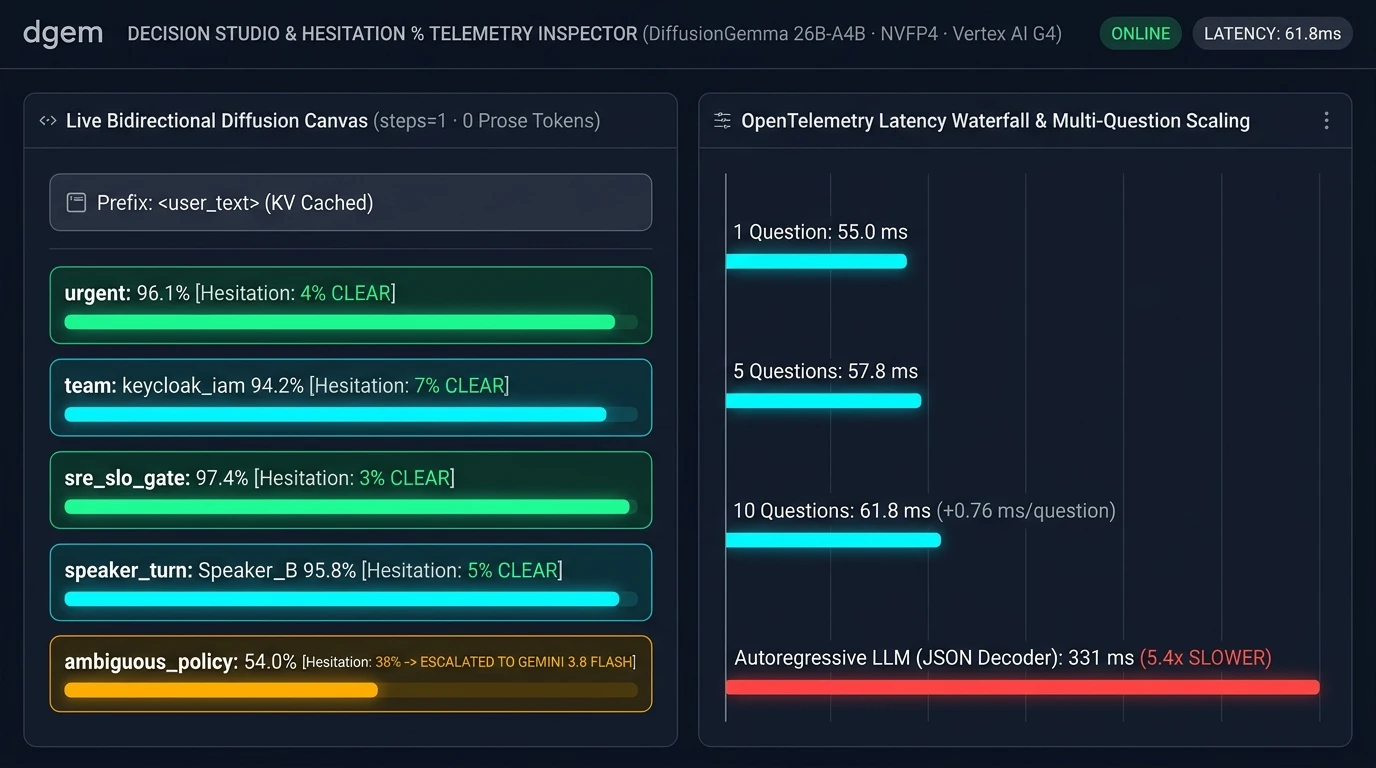 Inside
dgem Decision Studio (http://localhost:8080): inspecting live @ slot probability distributions, Hesitation % badges, and the OpenTelemetry trace waterfall across 1, 5, and 10 simultaneous questions (55.0 ms → 61.8 ms).
Use Case 3: Quick Speaker Detection & Multimodal Active-Speaker Diarization (55 ms Readout + dgem locate)
Let’s look at a third domain where sequential autoregressive decoding quietly wrecks user experience: real-time speaker detection and diarization in live meetings, customer discovery calls, and multilingual Brussels committee bridges.
Traditional real-time diarization pipelines get stuck between two bad options:
- Pure Acoustic Clustering (PyAnnote / x-vector embeddings alone): Fast, but outputs anonymous cluster IDs (
SPEAKER_00,SPEAKER_01), frequently splits a single speaker during rapid backchannels (“yes”, “d’accord”, “exact”), and has no semantic awareness of conversational roles. - Autoregressive LLM Diarization Repair: Feeding sliding ASR transcript windows into an LLM to label speakers and fix turn boundaries takes
400–850 msper utterance—far too slow for live sub-100ms captioning or real-time voice agent turn-taking.
Because google/diffusiongemma-26B-A4B-it is natively multimodal and evaluates all @ slots in one ~55 ms pass, dgem solves real-time speaker detection for diarization across both text+prosody streams and live video frames:
Part A: 55ms Lexical + Prosodic Turn Attribution (speaker_diarization_fast.json.tmpl)
Every time the streaming Voice Activity Detector (VAD) emits a candidate chunk boundary, we send the last 3 utterances + acoustic prosody deltas (pitch_hz_delta, pause_ms, overlap_ratio) to dgem:
// File: templates/speaker_diarization_fast.json.tmpl
// WHY: Real-time diarization cannot wait 500ms for an LLM to rewrite transcripts.
// In one 55ms diffusion pass, dgem resolves whether a true speaker turn change occurred,
// distinguishes backchannels from interruptions (with isolate:auto), and maps acoustic
// clusters to named meeting roles.
{
  "name": "Quick Speaker Detection & Diarization",
  "category": "audio_diarization",
  "layout": "document_first",
  "isolate": "auto",
  "questions": [
    {
      "name": "true_speaker_change",
      "type": "boolean",
      "prompt": "Did a genuine speaker turn change occur at [BOUNDARY], rather than a brief pause by the same speaker?"
    },
    {
      "name": "backchannel_only",
      "type": "boolean",
      "prompt": "Is the candidate segment after [BOUNDARY] merely a passive backchannel ('uh-huh', 'oui', 'right') that should not steal the primary floor?"
    },
    {
      "name": "speaker_role",
      "type": "choice",
      "prompt": "Which enrolled meeting participant spoke the segment after [BOUNDARY]?",
      "options": {
        "A": "incident_commander: chairs the bridge, assigns action items, asks for ETA",
        "B": "keycloak_iam_lead: reports on OIDC realms, token federation, and IdP logs",
        "C": "database_sre: reports on Spanner/Cloud SQL lock contention and replicas",
        "D": "customer_architect: reports on client-side SDK retries and business impact",
        "E": "unknown_participant: unauthenticated or external dial-in"
      }
    },
    {
      "name": "turn_escalation_score",
      "type": "score",
      "prompt": "Rate vocal and lexical urgency of the new turn from 1 (calm status update) to 5 (urgent interruption / critical alert).",
      "scale_min": 1,
      "scale_max": 5
    }
  ]
}
Part B: Multimodal Active-Speaker Grounding in Video Frames (dgem locate)
What if three people are sitting in the same Brussels conference room—or across a 9-tile Google Meet layout—and acoustic diarization says SPEAKER_02 is talking, but you need to know which visual participant tile or person is speaking right now?
Because dgem exposes zero-shot visual spatial grounding (dgem locate on the CLI, locate_object / locate_bounding_boxes over MCP, and image_b64 in /api/decide), achieving 78.7% accuracy on the vision_spot multimodal benchmark, you can ground the active speaker on a 3x3 spatial grid or bounding box in two diffusion passes with zero prose tokens:
# 1. Fast text + prosody speaker turn attribution in ~55ms:
dgem decide speaker_diarization_fast \
  --text "[Turn-1 | pitch=118Hz]: Rollback v2.4.8 is live in europe-west1. [BOUNDARY | pause=410ms | pitch=182Hz]: Confirmed, Keycloak OIDC token exchange latency is back down to 4 milliseconds." \
  --escalate-threshold 0.20

# 2. Zero-shot visual grounding on the conference room / Meet video frame:
dgem locate meeting_frame_1042.png \
  --target "the participant actively speaking into the table microphone with illuminated green speaker border"
4. Benchmark Deep Dive: dgem (Stock DiffusionGemma) vs. DecisionGemma (LoRA Gemma 4) vs. Autoregressive LLMs
At Google Cloud AI (cloud/ai/genaisa/), we built and benchmarked two complementary Decision Gemma architectures on the exact same Vertex AI G4 (g4-standard-48 + 1x NVIDIA RTX PRO 6000 96 GB) hardware so we could give engineering teams an unvarnished, data-backed architectural compass:
dgem(Hussain Chinoy): Uses 100% stock, frozengoogle/diffusiongemma-26B-A4B-it(NVFP4) weights. Compiles.json.tmplpolicies into adocument_firstprefix + seeded bidirectional@canvas (steps=1), applies inference-time calibration (isolate: auto, bracket tournament, per-type temperature scaling), and cascades high-hesitation slots (>= 16%) togemini-3.8-flash.DecisionGemma(Abhishek Bhagwat): Fine-tunes causal Gemma 4 26B-A4B (bf16) with an18.6M-parameter LoRA adapter (0.07%of weights) trained on244,272questions using a proper log-score rule, reading out up to255single-token option codes in a single causal prefill per question.
=====================================================================================
BENCHMARK 1: MULTI-QUESTION SCALING ON 1x RTX PRO 6000 (Vertex AI g4-standard-48)
=====================================================================================
Questions/Call | dgem (1-Step Diffusion Canvas) | DecisionGemma (Causal LoRA) | Winner
---------------|--------------------------------|-----------------------------|--------
1 Question     | 55.0 ms p50  (62.3 ms wall)    |  38.0 ms p50 ( 47.1 ms wall)| DecisionGemma (1.45x)
5 Questions    | 57.8 ms p50  (64.7 ms wall)    | 107.9 ms p50 (116.5 ms wall)| dgem (1.87x faster!)
10 Questions   | 61.8 ms p50  (68.8 ms wall)    | 115.7 ms p50 (124.2 ms wall)| dgem (1.87x faster!)
               | (+6.8 ms for 9 extra questions!| (+77.7 ms for 9 extra       | Crossover at M >= 2
               |  = +0.76 ms per extra question)|  questions)                 | questions!

=====================================================================================
BENCHMARK 2: DECISION INDEX LATENCY-V1 (n=750, Concurrency=1)
=====================================================================================
• DecisionGemma (Gemma 4 26B-A4B LoRA):    65.0 ms p50 |  136.0 ms p95
• dgem v0.3.1 (DiffusionGemma 26B-A4B):    66.1 ms p50 |  184.3 ms p95
• djev (Community DiffusionGemma port):    99.0 ms p50 |  146.0 ms p95
• pplx-decider v1.0 (1.13):               123.0 ms p50 |  234.0 ms p95
• Qwen 3.5 27B (Autoregressive):          236.0 ms p50 |  483.0 ms p95  (3.6x slower)
• Gemma 4 26B-A4B (Autoregressive):       331.0 ms p50 |  681.0 ms p95  (5.0x slower)
• Gemma 4 31B (Autoregressive):           567.0 ms p50 | 1140.0 ms p95  (8.6x slower)
=====================================================================================
The Head-to-Head Architectural Decision Matrix (EXP-27 & EXP-28)
| Architectural Dimension | dgem (Stock DiffusionGemma + Stage 2 Cascade) |
DecisionGemma (LoRA-Tuned Causal Gemma 4) |
Autoregressive LLM (response_schema JSON) |
|---|---|---|---|
| Fine-Tuning Required? | Zero (0 weights modified) — 100% policy-as-template (.json.tmpl) |
Yes (18.6M LoRA trained on 244k log-score examples) |
Zero, but requires prompt engineering per schema |
1-Question Server Latency (q1 p50) |
55.0 ms (66.1 ms on DI latency-v1) |
38.0 ms (1.45x faster on single question) |
236–567 ms (3.6x–8.6x slower) |
5 to 10 Questions Latency (q5–q10 p50) |
57.8 ms (5Q) / 61.8 ms (10Q) (+0.76 ms/extra Q!) |
107.9 ms (5Q) / 115.7 ms (10Q) (1.87x slower) |
350–1,100+ ms (Sequential JSON token tax) |
Unseen Zero-Shot Suite (n=333) |
88.6% Pass-1 / 98.0% w/ Stage 2 Cascade |
85.9% (dgem wins by +2.7 pts on unseen schemas) |
78%–86% (Uncalibrated confidence logprobs) |
Near-Distribution Tasks (n=210) |
91.9% (96.4%–97.7% on gate_mixed_noul) |
91.9% (Exact tie) |
80%–88% |
202-Tool Selection (workspace-tools-202) |
87.9% Top-1 / 95.0% Recall@7 (2-round bracket) |
92.6% Top-1 / 98.0% Recall@7 (1-pass 255-code LoRA) |
39.1% (BM25) / High token cost for full LLM |
202-Tool Conditional Arg Extraction (EXP-28) |
81.7% (+2.3 pts via joint multi-slot canvas fill) |
79.4% (74.3% vs 72.8% 2-RPC E2E) |
Requires full JSON generation pass |
Multimodal Spatial Grounding (vision_spot) |
Built-in (dgem locate — 78.7% accuracy) |
Text / JSON only | Requires heavy VLM coordinate decoding |
| When NOT to Use This Approach | Do NOT use if you need free-form prose explanations on every call, or 1-pass >100-option routing without a ~150ms 2-round bracket. |
Do NOT use if your policy rubrics change daily without a LoRA training pipeline, or when evaluating 5–10 questions + images per call. | Do NOT use for high-QPS closed-set triage, SRE autoraters, or <65ms speaker diarization gates. |
5. Serving Architecture & 8-Line MCP Integration
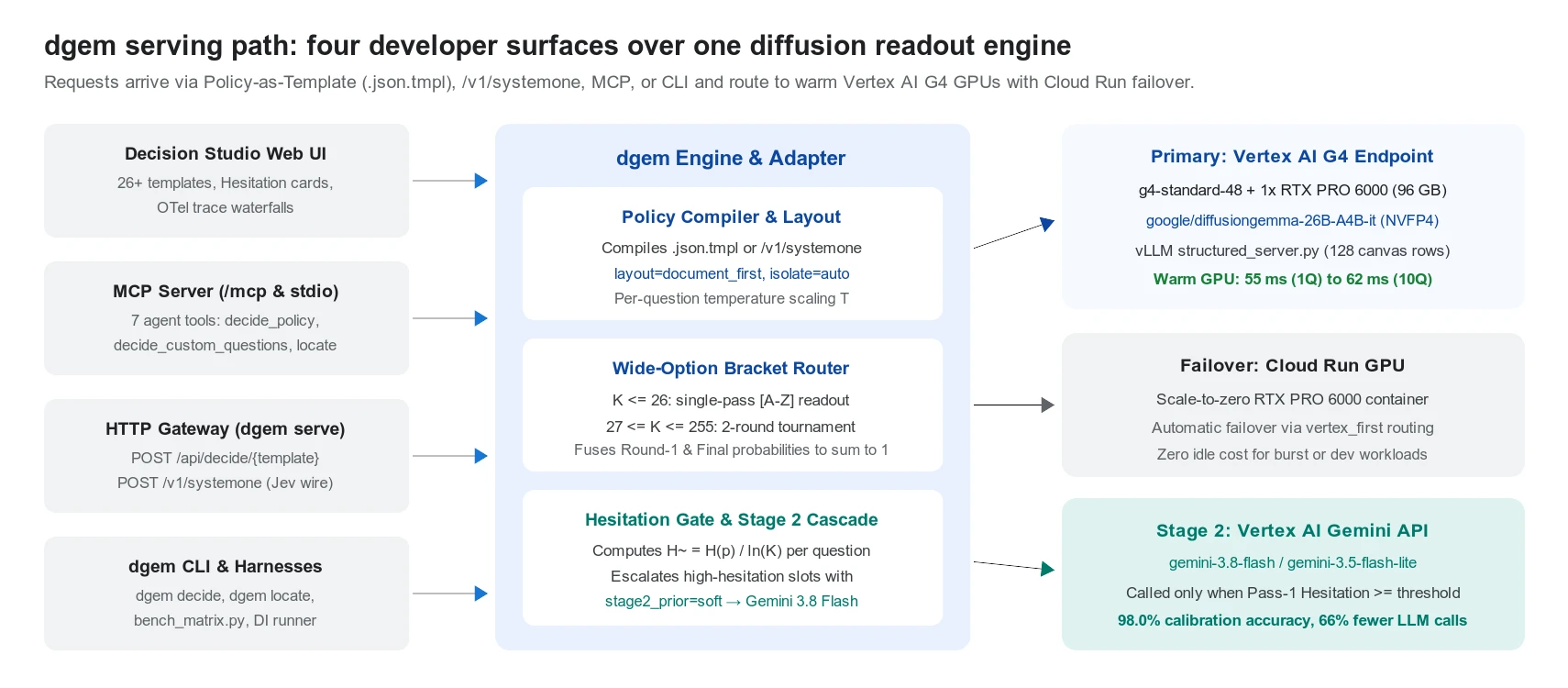 The
dgem serving architecture across Decision Studio, MCP Server, HTTP Gateway, and CLI, routing to warm Vertex AI G4 GPUs (g4-standard-48 + 1x RTX PRO 6000) with scale-to-zero Cloud Run GPU failover and Stage 2 Gemini 3.8 Flash cascade.
In production, dgem separates its policy compiler and routing gateway from the GPU diffusion worker (structured_server.py) using a vertex_first hybrid serving topology:
- Primary Path: Warm Vertex AI G4 endpoint (
g4-standard-48with 1x NVIDIA RTX PRO 6000 96 GB GPU runninggoogle/diffusiongemma-26B-A4B-itinNVFP4), delivering55 ms1-question and61.8 ms10-question server p50. - Scale-to-Zero Failover: Automatic failover to a Cloud Run GPU service (
RTX PRO 6000) for burst absorption or zero-idle-cost dev/staging environments. - Stage 2 Cascade: Vertex AI
gemini-3.8-flash(orgemini-3.5-flash-lite), invoked exclusively when a slot’snormalized_entropymeets or exceedsescalate_threshold.
To give your Agent Development Kit (ADK), Gemini CLI, Antigravity (agy), or Claude Code agent direct access to dgem’s 7 Model Context Protocol tools (decide_policy, decide_custom_questions, locate_object, locate_bounding_boxes, list_policy_templates, get_health_and_gpu_status, warmup_gpu), add eight lines to your mcp_config.json:
{
  "mcpServers": {
    "dgem": {
      "command": "dgem",
      "args": ["mcp"],
      "env": {
        "DGEM_BACKEND": "vertex_first"
      }
    }
  }
}
6. Railway Tracks → Compass: Spin Up dgem in 5 Minutes, Then Stress-Test Your Policies
I. The Railway Tracks (5-Minute Baseline)
Browse the open-source documentation and spin up the reference implementation to inspect live Hesitation % cards and OpenTelemetry trace waterfalls in Decision Studio (http://localhost:8080):
- Developer Documentation:
googlecloudplatform.github.io/dgem - GitHub Repository:
github.com/GoogleCloudPlatform/dgem - 1-Click Cloud Shell Sandbox: Open
GoogleCloudPlatform/dgemin Google Cloud Shell →
II. The Compass (Your Production Weekend Challenge)
Once your baseline template answers in <62 ms:
- Run the
isolate: autoContagion Ablation: Take your support triage or SRE guardrail template with 4 paired yes/no (boolean/noul) questions and benchmark accuracy and ECE withisolate: falsevs.isolate: "auto". Watch how isolating paired booleans into parallel canvas rows inside the same GPU batch eliminates yes/no confirmation bleed (59.5%→96.4%–97.7%). - Sweep Your FinOps Pareto Curve (
escalate_threshold): Runscripts/bench_matrix.pyon 100 historical support tickets or SRE incident traces acrossescalate_thresholdvalues from0.10to0.35. Plot the exact trade-off between Stage 2gemini-3.8-flashcall volume and end-to-end accuracy. - Wire Sub-60ms Speaker Attribution into Your Next Meeting Bridge: Hook
speaker_diarization_fast.json.tmplinto your streaming VAD/ASR pipeline and compare turn-attribution latency (~55 msfor 4 slots) against your current LLM transcript post-processor.
Now, if only we could pass steps=1, think=0, and isolate: "auto" to the next Council working group on Rue de la Loi. Until then, I’m going to enjoy a second espresso doppio before cycling across Parc du Cinquantenaire.