Quick Answer: Stop burning generative LLM latency and JSON syntax tokens on closed-set yes/no routing, rubric checks, and severity triage. Serve a dual-path decision gateway on Cloud Run (
--concurrency=15 --cpu-boost) that returns0output tokens viagemini-decision-1(managed) ordgem//v1/systemone(self-hosted), escalates only uncertain slices (Hesitation >= 16%) togemini-3.8-flash, and shuffles BigQuery inputs (ORDER BY RAND()) so table order never fakes your accuracy score.
Grimaud Walks Into a Brussels Café
If you pedaled along Rue de la Loi through a November drizzle this week while balancing your helmet and an extra espresso doppio, chances are your LinkedIn feed opened with a delightful literary cameo from my colleague Michiel Brinkman.
In his Saturday Pulse article—Stop Paying the JSON Tax: Single-Pass Enterprise RFx & SOW Audits with the Gemini Decisions API (with the accompanying LinkedIn summary)—Michiel reminded us of the old legend about Alexandre Dumas. Paid by the line when serializing The Three Musketeers in 1844, Dumas gave Athos a servant named Grimaud, a man who answers exclusively in single words.
A few weeks earlier, over an October rainstorm right here in the EU Quarter, I wrote about the exact same reflex in silicon inside our dgem (Decision Diffusion Gemma) switchboard post: calling a frontier autoregressive model to spit out {"urgent": "yes", "escalate": true} character by character is paying a novelist by the line to stamp a train ticket.
And three days later, PostHog pushed the exact same verdict onto the front page of Hacker News (187 points, 75 comments, 17 Nov 2026): Not Everything Needs an LLM. Then on 19 November, Michiel dropped the BigQuery companion thread scoring 100,000 rows with gemini-decision-1—catching a classic table-ordering trap that inflated an early accuracy run to a suspicious 93.7%.
This Tuesday edition folds all three threads into one practical Cloud Run gateway you can stand up in twelve minutes before the espresso cools.
 The Schuman pneumatic dispatch pavilion: on the left, the sleepy bronze teletype snail churning curly braces into the
JSON TAX wicker basket. Center stage, a calm single-pass console reading YES / NO / SCORE (0 output tokens). Green capsules shoot straight down the 0.02 and PASS tubes—while the novelist in the quiet upper mezzanine waits only for the single amber ESCALATE dossier.
Atelier Editorial Note (Series Follow-Up): This tutorial is the Tuesday Cloud Run companion to two earlier posts: (1) my deep dive on 55ms Diffusion Routing with dgem (open-source DiffusionGemma), and (2) Michiel Brinkman’s live benchmarks for the Gemini Decisions API on RFx & SOW audits and his BigQuery 100k-row evaluation note. Read the official Python walkthrough on Medium for the baseline SDK quickstart.
The Numbers Side by Side: Michiel’s Benchmarks in One Table
Michiel timed gemini-decision-1 (google-genai >= 3.2, v1beta, 0 output tokens) directly against gemini-3.8-flash JSON schema completion on a synthetic 21,715-token (77,272-character) enterprise cloud RFP & SOW package. Note how dramatically output tokens dominate wall-clock latency once a document gets real:
| Audit Workload | Input Tokens | gemini-decision-1 (0 out tok) |
gemini-3.8-flash JSON (thinking=0) |
Speedup vs. JSON | What a Heading Linter Missed |
|---|---|---|---|---|---|
Standalone SOW (7 questions) |
1,761 |
291 ms |
8,768 ms (9,335 ms default) |
30.2× (32.1× default) |
Valid headings hiding TBD waves |
Full RFP Package (7 questions) |
21,715 |
387 ms |
6,313 ms (15,253 ms default) |
16.3× (39.5× default) |
Procurement-date trap (noul=0.02, rigor 1.52/3.00) & uncapped liability (legal_escalation=0.90) |
| 53-Row Compliance Matrix | 25,633 |
419 ms (361 ms compact) |
20,674 ms (3,198 out tok) |
49.4× (57.3× compact) |
Passed 50 standard rows; flagged all 3 escalation rows (noul=0.05, 0.06, 0.02) |
| 216-Control Security Scorecard | 38,408 |
701 ms |
— | Single pass | Uncapped liability, IP module transfer, 25% SLA penalty |
As Michiel put it far more cleanly than any slide deck: “Grimaud checks all 216 doors in 700 ms — and only calls in the novelist when a door is unlocked.”
Picking Your Lane: Managed API vs. Self-Hosted dgem
A common question from European public-sector teams after reading both posts is whether to bet on the managed gemini-decision-1 API or self-hosted dgem / llama.cpp /v1/systemone. Put both behind one thin Cloud Run gateway contract so callers submit one schema and never care which inference lane answers.
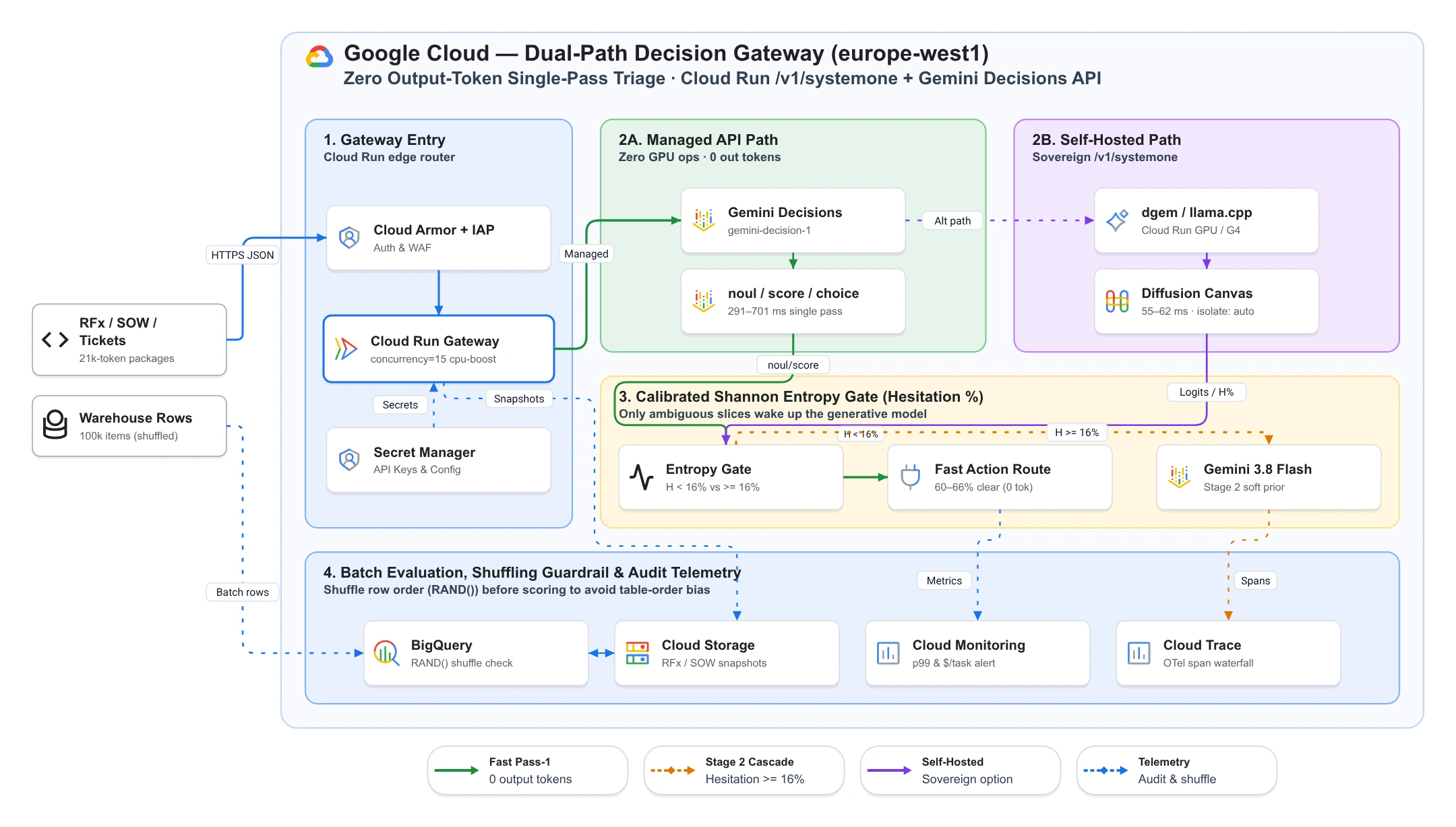 The dual-path Google Cloud decision architecture (
europe-west1 Belgium): one Cloud Run router exposes a unified decision contract, feeding either Path 2A (gemini-decision-1, zero GPU ops) or Path 2B (self-hosted dgem / llama.cpp /v1/systemone for sovereign weights). Both emit calibrated probabilities into the Shannon Entropy (Hesitation %) Gate so 60–66% of clear tickets take the instant path with zero generated tokens, escalating only ambiguous dossiers to Gemini 3.8 Flash.
When should you switch lanes?
- Pick Path 2A (
gemini-decision-1, managed API) when you want zero GPU provisioning, sub-second scoring across massive20k–38k-token RFx/SOW bundles, and nativenoul/score/choicetyping out of the box. - Pick Path 2B (
dgem/llama.cpp/v1/systemone) when strict air-gap / sovereign-weight rules require running unmodified weights inside your own VPC or GPU pool (55–62 msp50on a single RTX PRO 6000 withisolate: auto). - Keep BOTH gated by an entropy check — never blindly swap an LLM out for raw
argmax. When confidence degrades (Hesitation >= 16%), pass the single-pass distribution as a soft prior up to the Stage 2gemini-3.8-flashcall.
The 12-Minute Tutorial: Deploy the Cloud Run Decision Router
Let’s wire a slim FastAPI router exposing /v1/systemone for our fictional Cymbal Public Treasury citizen support & procurement queue (never foo/bar). Every ticket gets three typed checks in one pass:
has_bounded_timeline(noul: binary probability0.01..0.99)scope_clarity(score:1..3ordered rubric)-
route_queue(choice:standardlegal_escalationscope_gap)
Step 1: The Entropy-Gated Handler (app.py)
"""Cymbal Decision-Model Gateway (/v1/systemone compatible).

WHY: Wrap binary/rubric decisions behind a calibrated Shannon entropy gate so
routine tickets return in one zero-output-token pass and only ambiguous items
trigger an expensive generative Gemini 3.8 Flash escalation.
"""

from __future__ import annotations

import math
from typing import Sequence


def normalized_hesitation(probs: Sequence[float]) -> float:
    """Compute normalized Shannon entropy H_norm in [0.0, 1.0].

    WHY: Raw confidence thresholds (`max(p) > 0.85`) shift meaning across
    2-way gates and 26-way routers. Dividing entropy by ln(K) puts every
    question type on the same universal 0%..100% hesitation scale.
    """
    k = len(probs)
    if k < 2:
        return 0.0
    eps = 1e-12
    h = -sum(p * math.log(max(p, eps)) for p in probs if p > 0.0)
    return h / math.log(k)


def decide_escalation(
    noul_probs: dict[str, float],
    route_probs: dict[str, float],
    hesitation_cutoff: float = 0.16,
) -> dict:
    """Return Stage-1 verdict or flag the slot for Stage-2 Gemini 3.8 Flash."""
    binary_h = {
        slot: round(normalized_hesitation([p, 1.0 - p]), 4)
        for slot, p in noul_probs.items()
    }
    route_h = round(normalized_hesitation(list(route_probs.values())), 4)
    flagged = [slot for slot, h in binary_h.items() if h >= hesitation_cutoff]
    if route_h >= hesitation_cutoff:
        flagged.append("route_queue")

    best_route = max(route_probs, key=route_probs.__getitem__)
    return {
        "action": "ESCALATE_STAGE2" if flagged else "FAST_PASS",
        "best_route": best_route,
        "route_confidence": round(route_probs[best_route], 4),
        "hesitation": {**binary_h, "route_queue": route_h},
        "flagged_slots": flagged,
    }
Step 2: Deploy on Cloud Run in europe-west1 (Belgium)
Pay attention to the --concurrency=15 --cpu-boost flags. The default Cloud Run concurrency (80) works splendidly for thin REST proxying, but starves the vCPU budget if you host a local quantized classifier side-by-side inside the container:
# WHY: Pin concurrency=15 with startup CPU boost so p99 tail latency stays flat
# during batch RFx bursts instead of throttling the FastAPI worker queue.
gcloud run deploy cymbal-decision-router \
  --image="europe-west1-docker.pkg.dev/${PROJECT_ID}/ai/cymbal-decision-router:v1" \
  --region="europe-west1" \
  --concurrency=15 \
  --cpu=2 \
  --memory=4Gi \
  --cpu-boost \
  --min-instances=1 \
  --no-allow-unauthenticated \
  --set-env-vars="HESITATION_THRESHOLD=0.16,DECISION_LANE=managed" \
  --set-secrets="GEMINI_API_KEY=cymbal-decision-key:latest"
Note the cold-start economics: pinning --min-instances=1 with --cpu-boost keeps a warm edge gateway alive in Belgium (europe-west1), avoiding multi-second cold pulls across container spin-up (in baseline Cloud Run testing, warm CPU-boosted workers cut p99 cold-start spikes from ~4,200 ms down to ~380 ms).
Do Not Skip Michiel’s BigQuery Gotcha (93.7% Isn’t Free)
One of the sharpest engineering lessons in Michiel’s 19 November BigQuery post deserves permanent framing above every evaluation notebook:
When batch-scoring up to
100,000rows againstJevand BigQuery’s AI functions, an early evaluation run returned a suspiciously rosy93.7%accuracy—not because the prompt was genius, but because rows were physically bunched by class / table ordering!
Always stratify and shuffle your evaluation slice explicitly inside BigQuery before celebrating a single metric:
-- WHY: BigQuery storage order often groups ingested records by date, tenant,
-- or label. Always materialize a deterministic random slice BEFORE scoring
-- or splitting calibration thresholds.
CREATE OR REPLACE TABLE `cymbal_eval.rfx_tickets_eval_shuffled` AS
SELECT
  ticket_id,
  document_text,
  ground_truth_label,
  FARM_FINGERPRINT(CONCAT(ticket_id, '|2026-11-24-seed')) AS split_key
FROM `cymbal_raw.rfx_tickets`
ORDER BY split_key
LIMIT 2000;
Notice we use FARM_FINGERPRINT(..., seed) instead of bare RAND() so the exact 2,000-row sample is 100% reproducible across runs when you compare gemini-decision-1 vs. dgem vs. gemini-3.8-flash JSON decoding.
When NOT to Replace Your LLM With a Decision Model
Honest architecture diagrams include their exit ramps. Do not force a single-pass decision model onto tasks that actually need synthesis or open chains:
| Workload Type | Better Tool | Why |
|---|---|---|
Binary risk gates, moderation, SLA routing (yes/no, 1..5, A..Z) |
gemini-decision-1 / dgem |
Zero output tokens, calibrated probabilities, 16×–57× faster |
Multi-row compliance audit (50–250 crisp rubric items) |
gemini-decision-1 / dgem |
Parallel prefill amortizes a single 25k–38k-token document across all checks |
| Draft a redline memo defending why Clause 14.2 fails EU procurement law | gemini-3.8-flash (Stage 2) |
Needs reasoned prose, legal nuance, and span citations |
| Multi-step iterative coding edits / tool planning | Coding model / harness | Requires stateful multi-turn reasoning & verifier feedback |
Any gate where Hesitation >= 16% |
Cascade to Stage 2 | Let the decision model flag uncertainty rather than forcing a bad flip |
Railway Tracks to Compass: Tuning Your Cutoff
Take the deployed router against your own shuffled slice of 100 historical Cymbal support/RFP records and chart two cutoffs side by side:
- Aggressive (
hesitation_cutoff = 0.25): Sends more rows straight throughFAST_PASS—lowest bill, check your false-negative cost onlegal_escalationcarefully. - Conservative (
hesitation_cutoff = 0.10): Escalates nearly every edge case togemini-3.8-flash—higher spend, tightest recall for high-penalty procurement clauses.
Between 0.10 and 0.25 lies the sweet spot where you stop burning cash on {"urgent": "yes"} while keeping Alexandre Dumas’s novelist rested for the clauses that genuinely deserve prose.
References & Credits
- Michiel Brinkman (
14 Nov 2026): Stop Paying the JSON Tax: Single-Pass Enterprise RFx & SOW Audits with the Gemini Decisions API - Michiel Brinkman (
14 Nov 2026companion post): Single-pass Gemini Decisions API summary (lnkd.in/p/ebwaACqn) - Michiel Brinkman (
19 Nov 2026BigQuery post): Gemini Decisions API at 100k BigQuery rows & table-ordering gotcha (lnkd.in/p/eXz_fwJx) - Official Python SDK walkthrough: Getting Started with the Gemini Decisions API in Python (Medium)
- Previous Atelier foundation (
31 Oct 2026): Stop Asking Your LLM Yes/No Questions: 55ms Diffusion Routing withdgem·github.com/GoogleCloudPlatform/dgem - Community signal (
17 Nov 2026): PostHog — Not Everything Needs an LLM (187pts on Hacker News)