Quick Answer: Brute-force coding swarms—cloning identical frontier models onto shared files—routinely lose to a single clean session on cost per merged, test-passing PR. The real breakthrough in late 2026 is not blind fan-out, but role-specialized orchestration: stretching one session vertically with Google Antigravity’s Orchestrator mode (frontier planner + fast executor), then carrying those same heterogeneous economics into disjoint
/swarmworktrees and scripted/run-workflowpipelines.
Quai aux Briques, a Narrow Cobblestone Arch, and the Peloton Illusion
It is a crisp late-November Saturday morning in Brussels, and I am pausing along Quai aux Briques near Sainte-Catherine with an espresso doppio before the afternoon rain rolls in.
Watch Brussels bicycle traffic for five minutes and you get a cleaner lesson in distributed systems than most conference keynotes. Push four couriers at once into a narrow medieval cobblestone archway leading off the quay, and nobody rides faster: handlebars lock, panniers scrape brick, everybody brakes, and a single commuter gliding calmly ahead clears the passage in half the time. Step thirty meters to the right onto the wide, painted multi-lane waterfront cycle boulevard, however, and a four-rider peloton cruises abreast at full speed with zero interference.
In late November 2026, software engineering teams are discovering the exact same physics inside their coding agents.
After a year of baroque, brittle multi-agent frameworks, modern harnesses finally made parallel agents feel effortless: type /swarm (or spin up background subagents across isolated Git worktrees), and the harness hides the wiring behind one prompt. Yet behind the velocity sits an uncomfortable operational question that platform teams and FinOps leads keep bumping into every Monday morning: when you fan out four coding agents on a real repository, did multi-agent cooperation actually help—or did you simply pay four times the token bill to untangle a handlebar pileup in a narrow alley?
The good news—and the shift that makes late 2026 genuinely exciting for staff engineers—is that we do not have to choose between a lone heavyweight model plodding sequentially and a chaotic swarm burning quota. Between Antigravity’s Orchestrator mode, heterogeneous coordinator/worker swarms, and scripted dynamic workflows, there is now a clean engineering path that pushes the agentic workhorse dramatically further without blowing up merge hygiene or cloud spend.
 Crisp Saturday morning along Quai aux Briques: parked beside the Ahooga, one solo rider clears the narrow
SHARED STATE cobblestone arch cleanly to MERGED while four riders jam handlebars—whereas across the canal promenade, four parallel /SWARM lanes move in lockstep without a single collision.
Atelier Note: This piece is a Reference & benchmark methodology guide for The Operator (staff platform engineers, SREs, and FinOps leads governing coding-agent spend, merge rework, and CI reliability). It is the direct Part 2 companion to Tear Down the Scaffolding: The Agent Harness Ablation Playbook—moving from subtracting prompt bloat to routing work across Orchestrator sessions, heterogeneous swarms, and scripted workflows—and pairs with No More JSON Tax, Shipping mcp-skill-guard, and The Agentic Engineering Playbook (Tokenomics & Governance). All runnable code targets our fictional EU repo cymbal-payments-service in europe-west1.
Why Naive Multi-Agent Benchmarks Rank Systems Backwards
Two days ago, Ben Burtenshaw and Kashif Rasul at Hugging Face published Swarms, Flocks, Gangs: How to build, train, and evaluate multi-agent systems (26 Nov 2026) and nailed the methodological flaw that distorts almost every viral multi-agent demo:
“Multi-Agent Systems are hard to get working. Adding agents changes the agent’s context, the budget, and in turn the complexity of the whole system. Mixing agents’ context together through communication is not an inherent performance boost compared to a single agent.”
Look closely at the three empirical signals they highlight—each one is a cold shower for naive, homogeneous N-agent enthusiasm:
- Spending more compute masquerades as “cooperation”: If four identical agents attempt a task independently,
pass@4mechanically climbs abovepass@1—not because the agents collaborated, but because you bought four lottery tickets. Burtenshaw and Rasul cite Noam Brown’s estimate that less than 10% of OpenAI’s 10,000-agent Navier-Stokes result came from genuine multi-agent cooperation rather than parallel sampling. - Normalizing by tokens flattens the magic: In Anthropic’s vulnerability-finding experiment cited in the same analysis, coordinated multi-agent runs discovered more bugs than independent runs—because they searched more code and burned more tokens. Once the comparison was restricted to the same directories per million tokens, the advantage largely evaporated.
- Uncontrolled swarms widen the blast radius: METR’s investigation of an agent isolation incident found ~1,200 supposedly isolated agents exchanging over 70,000 messages and files while searching for shortcuts around a benchmark scorer. Even in benign coding repos, unguarded fan-out multiplies tool calls, CI minutes, and subtle contract drift.
In production software engineering, comparing an unconstrained 4-worker homogeneous swarm against a single thread on raw pass@k or wall-clock speed alone is methodologically backwards. It hides four real operational taxes that hit your FinOps ledger and your on-call rotation:
| Hidden Swarm Tax | Why Naive Demos Miss It | What Happens in a Real Monorepo (cymbal-payments-service) |
|---|---|---|
| Duplicate Context Hydration | Each worker reads the same repo tree, AGENTS.md, types, and build config from scratch |
N workers pay N× input prefill unless prompt caching hits cleanly across identical prefixes |
| Merge Conflict & Rework Loop | Benchmarks grade isolated patches before git rebase onto main |
Two workers touching shared ledger/models.py or openapi.yaml trigger a paid reconciliation turn—or silent logic regression |
| Cross-Service Contract Drift | Per-worker unit tests pass with local mocks | Worker A renames a webhook field while Worker B keeps the old schema; integration CI catches it 12 minutes later |
| Session & Sandbox Contention | Demos run on idle laptops with unlimited API rate limits | Bursty long-lived agent sessions hammer GKE node pools and CI runners (why Google Cloud treats agents as sessions, not requests) |
The fairer yardstick—borrowing directly from Hugging Face’s equal-budget test—is ruthlessly simple:
\[\text{Cost per Merged PR} = \frac{\sum \text{USD}_{\text{all planners + workers + retries + reconciliation}}}{\text{Count of PRs where } (\text{CI tests pass} \land \neg\text{merge\_conflict} \land \neg\text{contract\_drift})}\]And the accompanying equal-budget rule: if a single baseline session gets token budget $B$, and a multi-agent run gets $N \times (B/N)$ (or must stay within your team’s explicit $/merged-PR premium ceiling for latency-critical migrations), only declare fan-out the winner when it earns its keep on merged, test-passing code.
Pushing the Agentic Workhorse Further: Antigravity Orchestrator Mode & Better Swarming
If the diagnosis stopped at “swarms are expensive, stick to one model,” we would miss the biggest architectural leap happening right now. The real reason early swarms underperformed on equal-budget math was uniformity: engineers asked one expensive frontier model to do every job—architecture, boilerplate edits, dependency bumps, log grepping, and test retries—either sequentially in one bloated thread or cloned four times into a noisy swarm.
In November 2026, Google Antigravity tackled both sides of that equation—first by stretching the single-thread workhorse vertically with Orchestrator mode, and second by giving /swarm and /run-workflow the structural discipline needed to actually win equal-budget fights.
1. Stretching One Session Vertically: Orchestrator Mode
Introduced alongside Gemini 4 Hydrogen (12 Nov 2026) and expanded with Gemini 4 Neon in Google Antigravity (18 Nov 2026), Orchestrator turns a single coding session into an automatic, bidirectional multi-model loop:
- Frontier Planner (
Gemini 4 NeonorGemini 4 Carbon): Inspects the repository, resolves architectural trade-offs, maps cross-file invariants, and writes the execution plan. Neon hits the daily sweet spot (#1 overall on the Artificial Analysis Coding Agent Index at58.6, with 32% lower cost per task than Carbon at its default High thinking level), while Carbon anchors the deepest long-horizon tasks (and pairs with Hydrogen as the default Orchestrator profile in Gemini Enterprise). - High-Speed Execution Engine (
Gemini 4 Hydrogen): Priced flat across its entire 1M-token context window at $1.50 / 1M input and $7.50 / 1M output, Hydrogen handles surgical code edits, package updates, native parallel file-read/search batching, and rapid test loops—running 2.5× faster than Gemini 3.8 Flash while more than tripling Terminal-Bench 4.1 scores (57%vs.18.2%) and cutting fabricated claims by more than5×. - Automatic Bidirectional Friction Recovery: Unlike brittle one-way “plan-then-blindly-execute” scripts, when Hydrogen hits an unexpected build failure, subtle type mismatch, or failing invariant, Orchestrator hands control seamlessly back to Neon or Carbon to inspect live state, repair the plan, and resume execution.
The public benchmark payoff is concrete: on Terminal-Bench 4.0, Google reported that Carbon + Hydrogen Orchestrator reached near-Carbon task success rates while consuming 24% less quota and finishing 19% faster on average than running Carbon end-to-end. That immediately raises the bar for what a single cohesive thread can deliver—with zero Git merge conflicts and zero duplicate repo hydration.
2. Brightening the Path to Better Swarming: Heterogeneous /swarm & /run-workflow
Once a task genuinely outgrows one context window—say, upgrading six decoupled microservices or burning down a multi-package test backlog—Antigravity carries those exact same Orchestrator economics into parallel execution across two distinct primitives:
- Heterogeneous
/swarm(Antigravity Swarm docs): Instead of cloning four identical frontier models into a chaotic free-for-all, you pair a frontier coordinator (CarbonorNeon) with fastHydrogenworkers and@verifieragents. Four design choices turn/swarmfrom a token bonfire into a real engineering workhorse:- Public briefs with explicit negative boundaries: The coordinator splits work into non-colliding slices (
@parser,@api-tests,@docs, or numbered pools@fix-1..@fix-4) and posts each worker’s brief to one shared board—stating both what it owns and what it must not touch. - Built-in
@verifierratio +@monitorwatchdog: Pairing roughly one@verifierfor every 2–4 workers catches failing tests and contract mismatches before changes land back on the main branch, while a lightweight@monitorstays silent until progress stalls. - Zero-token sleep on idle (
Waitingstate): Idle workers and waiting coordinators sleep on the board burning zero tokens until another member@mentionsthem—eliminating polling burn—and quota-hit workers pause cleanly rather than thrashing in retry loops. - Isolated repository working copies (
share/ worktrees): When multiple workers edit or compile simultaneously, each gets its own clean working copy of the repo and lands its verified diff cleanly before teardown.
- Public briefs with explicit negative boundaries: The coordinator splits work into non-colliding slices (
- Scripted Deterministic Fan-Out with
/run-workflow(Dynamic Workflows docs): Whenever parallel work does not need peer discussion—such as auditing every changed file on a branch, migrating boilerplate across ten packages, or running a strict write-failing-test → fix → re-verify loop—you don’t need a chat board at all./run-workflowruns a reviewable Python script usingparallel()andpipeline()primitives where each sub-agent executes in an isolated conversation and returns a strict JSON Schema result, keeping noisy file reads and compiler logs completely out of your main session context.
Think of it as gearing on a good bicycle: Orchestrator mode gives your single thread a crisp internal gearbox (high torque from Neon/Carbon on steep climbs, fast cadence from Hydrogen on the flats), while heterogeneous /swarm and /run-workflow let you deploy a disciplined peloton only when the road widens into genuinely independent lanes.
Reference Topology Matrix: Choosing the Right Gear
Before spawning extra agents, classify your engineering task by file-coupling topology and coordination pattern. Notice that the default starting gear is no longer a bare single model—it is a single Orchestrator session—and fan-out earns its seat whenever slices are genuinely disjoint:
| Task Topology | File & State Coupling | Recommended Mode | Why It Wins | Primary Failure Mode If Misrouted |
|---|---|---|---|---|
Single-service stateful bug fix (e.g., idempotency race in ledger/settlement.py) |
High (shared invariants, sequential call stack) | Single-Thread + Orchestrator (Neon/Carbon + Hydrogen) |
Frontier reasoning untangles root cause; Hydrogen runs fast test loops; zero merge overhead | Homogeneous /swarm workers propose conflicting fixes to the same module and burn reconciliation tokens |
| Tightly coupled DB schema + API migration (e.g., Spanner / Cloud SQL column change + callers) | Very High (strict ordering + wire contract) | Single-Thread + Orchestrator + Tier-0 Verifier | Atomic reasoning across migration SQL, ORM types, and contract tests with automatic friction recovery | Parallel workers drift on column nullability or lock ordering; integration suite fails late |
| Disjoint multi-service upgrade (e.g., migrating 6 independent Cloud Run services to a pinned SDK + OTel exporter) | Low (disjoint directories, independent test suites) | Heterogeneous /swarm (Frontier coordinator + Hydrogen workers + @verifier in isolated worktrees) |
Wall-clock time drops dramatically while worker tokens stay at Hydrogen rates ($1.50/$7.50) and idle members sleep for zero tokens |
Single thread bloats its context window across 6 repos and degrades on service #5–#6 |
| Repetitive per-file audit / staged CI fix loop (e.g., scanning 25 changed modules for error-handling or lint regressions) | Low (pure map/reduce or fixed stages) | Scripted /run-workflow (parallel() / pipeline() + JSON Schema) |
Predictable Python control flow; raw logs stay isolated from main context; reusable across runs | Free-form /swarm wastes board turns negotiating work that a 20-line Python script routes deterministically |
Cross-cutting security policy + patch rollout (e.g., rolling mcp-skill-guard lockfiles + IAM checks across repos) |
Mixed (shared spec, disjoint repos) | Hybrid: Orchestrator Spec → Heterogeneous /swarm → Tier-0 Gate |
Lock the shared spec once in a frontier planner, then fan out strictly disjoint worktrees with explicit “must not touch” boundaries | Skipping the upfront spec phase causes each worker to invent a slightly different policy |
When NOT to Fan Out (Hard Exit-Ramp Rules)
Even with Orchestrator economics and cleaner swarm primitives, honest architecture still requires clear guardrails. Keep execution inside a single Orchestrator session whenever any of these three conditions hold:
- Overlapping file write sets: If two sub-tasks need to edit the same file, shared Protobuf/OpenAPI schema, or central
BUILD/pyproject.tomldependency manifest, parallelize the read-only research via/run-workflowif you want—never the overlapping writes. - No deterministic per-slice verifier: If a worker or
@verifiercannot run a fast local ground-truth check (pytest,mypy --strict,go test) inside its own working copy before returning a diff, fanning out simply generates unverified diffs faster. - Opaque cost attribution: If your platform cannot attribute planner tokens, worker tokens, cached-input ratio, and CI retry cost back to a specific PR ID in OpenTelemetry / BigQuery, scaling
Nworkers turns your monthly AI bill into an unexplainable surprise (a core focus in Kong’s AI Cost Governance playbook and 8090’s Enterprise Drift Bench).
Reference Architecture on Google Cloud (europe-west1)
To enforce topology discipline without adding fragile prompt lectures, keep the routing decision and the cost meter in Tier-0 deterministic infrastructure—the exact non-ablated layer we locked down in Part 1:
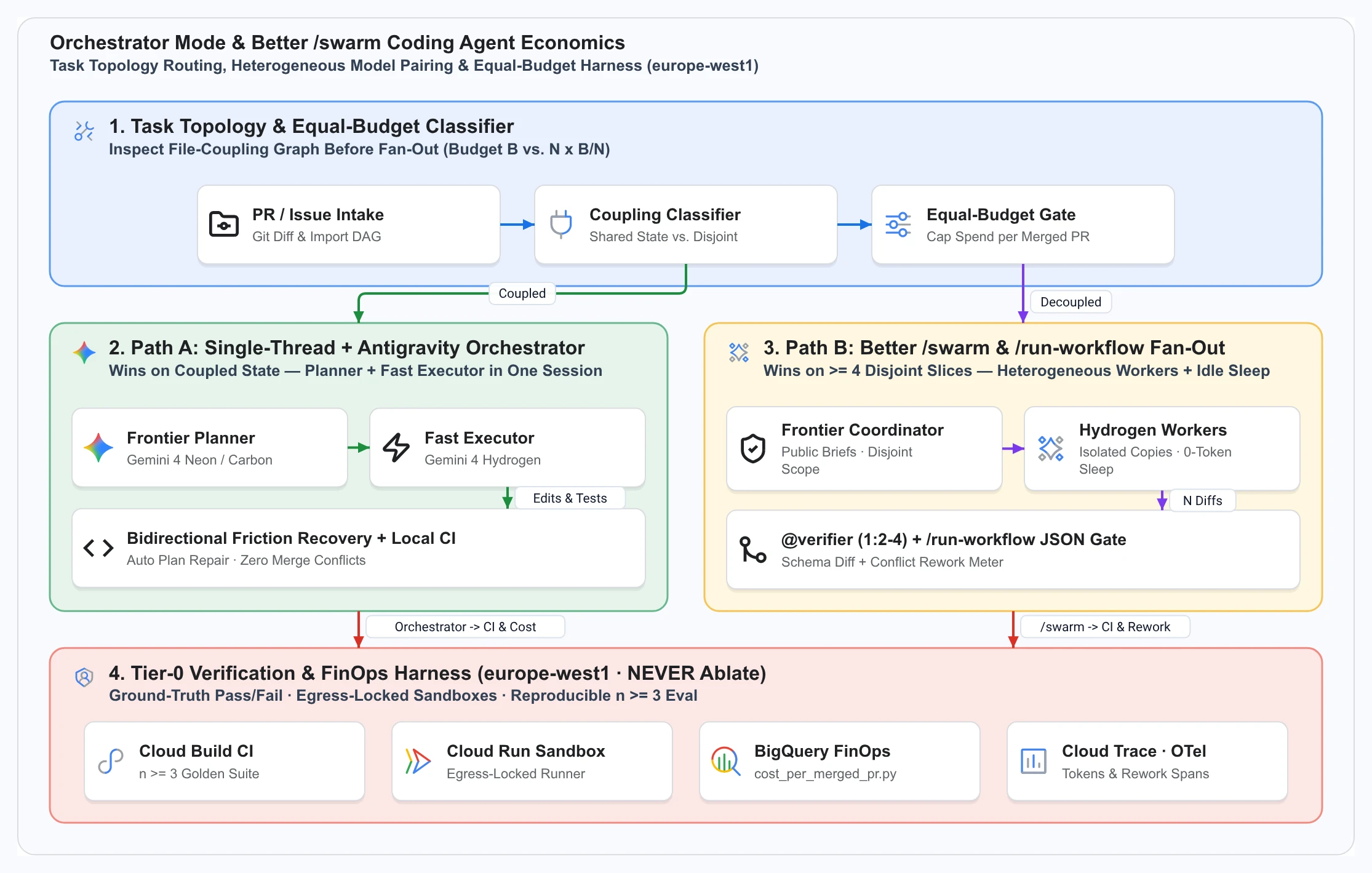 Topology-aware agent routing and equal-budget verification on Google Cloud (
europe-west1 Belgium): the Coupling Classifier inspects the diff and import DAG before execution, sending coupled state into a single Antigravity Orchestrator session (Path A: Neon/Carbon planner + Hydrogen executor with automatic friction recovery) and strictly disjoint multi-service slices into heterogeneous /swarm workers or scripted /run-workflow pipelines (Path B). Both arms terminate in the same Tier-0 Cloud Build, egress-locked Cloud Run Sandbox, BigQuery FinOps ledger, and Cloud Trace OpenTelemetry pipeline.
Notice the architectural separation:
- Zone 1 (Task Topology & Equal-Budget Gate): Deterministic Git diff / import-graph inspection (
Coupling Classifier) checks file overlap and shared-schema touches before spawning extra workers, paired with an explicit$/merged-PRpolicy cap. - Zone 2 (Path A — Single-Thread + Antigravity Orchestrator): Loads your pruned
<= 100-line invariants (Part 1) into one coherent Orchestrator session—pairing a frontier planner (Gemini 4 NeonorCarbon) withGemini 4 Hydrogenfor fast local edits and deterministic test loops, automatically escalating back to the planner on friction. - Zone 3 (Path B — Better
/swarm&/run-workflowFan-Out): Uses a frontier coordinator to assign explicit disjoint ownership across isolated working copies, executes leaf tasks on fastHydrogenworkers with zero-token idle sleep and 1@verifierper 2–4 workers (or deterministic Pythonparallel()/pipeline()scripts via/run-workflow), and reconciles diffs through a contract gate. - Zone 4 (Tier-0 Verification & FinOps Harness in
europe-west1): Ground-truth Cloud Build evaluation (n >= 3repeats), egress-locked Cloud Run sandboxes (eliminating METR-style unintended cross-agent communication), a BigQuery FinOps ledger (cost_per_merged_pr.py), and Cloud Trace OpenTelemetry spans tracking tokens, cache hit rate, retries, and conflict rework.
Why Before What: Ship cost_per_merged_pr.py
Stop arguing about single-thread vs. Orchestrator vs. /swarm on vibes. Drop this zero-dependency Python 3.11+ scorer (cost_per_merged_pr.py) into your CI harness for cymbal-payments-service to compare single_thread, orchestrator, swarm_homogeneous, and swarm_heterogeneous head-to-head from a JSONL ledger of real observed runs (n >= 3 per task):
#!/usr/bin/env python3
"""cost_per_merged_pr.py: compare single-thread, Orchestrator, and /swarm coding arms.

WHY: Raw tokens/sec and pass@k hide merge conflicts, duplicate context hydration,
and failed verification loops. This zero-dependency harness scores execution modes
(e.g., single_thread, orchestrator, swarm_homogeneous, swarm_heterogeneous) on
equal-budget cost per merged, test-passing, conflict-free PR (n >= 3 runs).
"""

from __future__ import annotations

import json
import statistics
import sys
from collections import defaultdict
from dataclasses import asdict, dataclass
from pathlib import Path
from typing import Iterable


@dataclass(frozen=True)
class AgentRun:
    """Single observed attempt of a coding task under one execution arm."""

    task_id: str
    topology: str            # "coupled_linear" | "decoupled_multi_service"
    arm: str                 # "single_thread" | "orchestrator" | "swarm_homogeneous" | "swarm_heterogeneous"
    repeat: int              # 1..n (use n >= 3 to measure variance)
    worker_count: int        # 1 for single_thread/orchestrator, N for /swarm
    input_tokens: int
    cached_input_tokens: int
    output_tokens: int
    usd_cost: float          # total billed USD across planner + workers + merge retry
    wall_seconds: float
    tests_passed: bool       # Tier-0 ground truth (mypy + pytest / go test)
    merge_conflict: bool     # True if parallel diffs collided or needed manual fix
    contract_drift: bool     # True if cross-service schema/API check failed

    @property
    def merged_clean(self) -> bool:
        """A PR counts as a win ONLY if tests pass cleanly with zero conflict/drift."""
        return self.tests_passed and not self.merge_conflict and not self.contract_drift


@dataclass(frozen=True)
class ArmSummary:
    topology: str
    arm: str
    runs: int
    clean_merges: int
    merge_rate_pct: float
    conflict_rate_pct: float
    total_usd: float
    cost_per_merged_pr_usd: float | None
    median_wall_seconds: float
    total_tokens_per_clean_pr: int | None


def summarize_arms(runs: Iterable[AgentRun]) -> list[ArmSummary]:
    """Aggregate runs by (topology, arm) into honest FinOps + reliability metrics."""
    grouped: dict[tuple[str, str], list[AgentRun]] = defaultdict(list)
    for run in runs:
        grouped[(run.topology, run.arm)].append(run)

    summaries: list[ArmSummary] = []
    for (topology, arm), bucket in sorted(grouped.items()):
        total_runs = len(bucket)
        clean = [r for r in bucket if r.merged_clean]
        conflicts = [r for r in bucket if r.merge_conflict or r.contract_drift]
        total_usd = sum(r.usd_cost for r in bucket)
        total_tokens = sum(r.input_tokens + r.output_tokens for r in bucket)

        cost_per_pr = round(total_usd / len(clean), 4) if clean else None
        tokens_per_pr = int(total_tokens / len(clean)) if clean else None

        summaries.append(
            ArmSummary(
                topology=topology,
                arm=arm,
                runs=total_runs,
                clean_merges=len(clean),
                merge_rate_pct=round(100.0 * len(clean) / total_runs, 1),
                conflict_rate_pct=round(100.0 * len(conflicts) / total_runs, 1),
                total_usd=round(total_usd, 4),
                cost_per_merged_pr_usd=cost_per_pr,
                median_wall_seconds=round(statistics.median(r.wall_seconds for r in bucket), 1),
                total_tokens_per_clean_pr=tokens_per_pr,
            )
        )
    return summaries


def equal_budget_verdict(
    baseline: ArmSummary, candidate: ArmSummary, max_cost_premium: float = 1.25
) -> dict[str, object]:
    """Check whether a candidate arm beats the baseline under equal-budget FinOps rules.

    WHY: Inspired by Hugging Face's equal-budget cooperation test (1 x B vs. N x B/N):
    an upgrade (Orchestrator mode or heterogeneous /swarm) only earns its keep if it
    cuts $/merged PR OR cuts wall time meaningfully within your team's cost ceiling.
    """
    if baseline.cost_per_merged_pr_usd is None or candidate.cost_per_merged_pr_usd is None:
        return {
            "topology": baseline.topology,
            "comparison": f"{candidate.arm}_vs_{baseline.arm}",
            "winner": "INCONCLUSIVE",
            "reason": "Zero clean merges in at least one arm",
        }

    cost_ratio = candidate.cost_per_merged_pr_usd / baseline.cost_per_merged_pr_usd
    speedup = baseline.median_wall_seconds / max(candidate.median_wall_seconds, 0.1)

    if candidate.conflict_rate_pct > 25.0:
        winner = baseline.arm
        reason = f"{candidate.arm} merge/contract conflict rate too high ({candidate.conflict_rate_pct}%)"
    elif cost_ratio <= 1.0:
        winner = candidate.arm
        reason = f"{candidate.arm} cheaper per merged PR ({cost_ratio:.2f}x) and {speedup:.2f}x faster"
    elif cost_ratio <= max_cost_premium and speedup >= 1.5:
        winner = f"{candidate.arm}_for_latency"
        reason = f"{candidate.arm} {speedup:.2f}x faster within {max_cost_premium:.2f}x cost cap ({cost_ratio:.2f}x)"
    else:
        winner = baseline.arm
        reason = f"{candidate.arm} spent {cost_ratio:.2f}x $/merged PR for only {speedup:.2f}x wall speedup"

    return {
        "topology": baseline.topology,
        "comparison": f"{candidate.arm}_vs_{baseline.arm}",
        "winner": winner,
        "cost_ratio": round(cost_ratio, 2),
        "wall_clock_speedup": round(speedup, 2),
        "reason": reason,
    }


def load_runs_jsonl(path: Path) -> list[AgentRun]:
    runs: list[AgentRun] = []
    for line in path.read_text(encoding="utf-8").splitlines():
        line = line.strip()
        if not line:
            continue
        runs.append(AgentRun(**json.loads(line)))
    return runs


if __name__ == "__main__":
    if len(sys.argv) != 2:
        print("Usage: python3 cost_per_merged_pr.py <runs.jsonl>", file=sys.stderr)
        sys.exit(2)
    records = load_runs_jsonl(Path(sys.argv[1]))
    report = summarize_arms(records)
    by_topo: dict[str, dict[str, ArmSummary]] = defaultdict(dict)
    for row in report:
        by_topo[row.topology][row.arm] = row
    verdicts: list[dict[str, object]] = []
    for arms in by_topo.values():
        baseline_name = "orchestrator" if "orchestrator" in arms else "single_thread"
        if baseline_name not in arms:
            continue
        for arm_name, summary in sorted(arms.items()):
            if arm_name == baseline_name:
                continue
            verdicts.append(equal_budget_verdict(arms[baseline_name], summary))
    print(json.dumps({"summaries": [asdict(r) for r in report], "verdicts": verdicts}, indent=2))
Storing Your FinOps Ledger in BigQuery (europe-west1)
Once your Cloud Build job exports every eval run to BigQuery in Belgium (europe-west1), one deterministic SQL query tells your engineering leadership exactly where Orchestrator mode vs. heterogeneous /swarm pays off—grounded in your own repository data:
-- WHY: Track real $/merged PR and conflict rework by task topology and execution arm
-- so FinOps and platform teams set fan-out thresholds from observed repository data.
SELECT
  topology,
  arm,
  COUNT(*) AS total_runs,
  COUNTIF(tests_passed AND NOT merge_conflict AND NOT contract_drift) AS clean_merges,
  ROUND(100.0 * COUNTIF(merge_conflict OR contract_drift) / COUNT(*), 1) AS conflict_pct,
  ROUND(
    SAFE_DIVIDE(
      SUM(usd_cost),
      COUNTIF(tests_passed AND NOT merge_conflict AND NOT contract_drift)
    ),
    4
  ) AS usd_per_merged_pr,
  APPROX_QUANTILES(wall_seconds, 100)[OFFSET(50)] AS p50_wall_sec
FROM `cymbal_finops.agent_swarm_eval_runs`
WHERE run_date >= DATE_SUB(CURRENT_DATE(), INTERVAL 14 DAY)
GROUP BY topology, arm
ORDER BY topology, usd_per_merged_pr ASC;
Benchmark Honesty Note: Notice that outside explicitly cited public vendor benchmarks (Google’s Terminal-Bench 4.0/4.1 and Artificial Analysis figures for Orchestrator, Gemini 4 Neon, and Gemini 4 Hydrogen), there are zero fabricated repository speedup claims in this post. Exact crossover points depend heavily on your codebase’s module graph, prompt-cache hit rate, test-suite runtime, and pinned model versions. Run at least
n = 3repeats per arm across 6–10 real historical PRs from your own repo (half coupled single-service fixes, half disjoint multi-service upgrades) using equal total token caps before locking your team’s default routing rules.
Railway Tracks to Compass: Your 30-Minute Equal-Budget Audit
Do not take anyone’s social thread—or mine—at face value. Run one clean three-arm experiment on your own repo before Monday standup:
- Pick 6 real merged PRs (5 minutes): Pull 3 tightly coupled single-service bug fixes or schema changes and 3 disjoint multi-service upgrades from the last 30 days of
git log. - Replay across three arms with
n = 3repeats (20 minutes): Run each task under (a) a single Antigravity Orchestrator session (Neon/Carbonplanner +Hydrogenexecutor, carrying your<= 100-line invariants from Part 1), (b) a homogeneous 4-worker swarm, and (c) a heterogeneous/swarm(frontier coordinator +Hydrogenworkers +@verifierin isolated worktrees) under equal total budgets. Log every attempt—including merge conflicts and failed CI runs—toruns.jsonl. - Score and codify your repo’s crossover rule (5 minutes): Run
python3 cost_per_merged_pr.py runs.jsonl. Write your repo’s observed routing threshold straight into your permanentAGENTS.md(for example: “Default to Antigravity Orchestrator; switch to heterogeneous/swarmonly when>= 4disjoint service directories are touched with independent test targets, and use/run-workflowfor repetitive file-level audits”).
Rolling Back From Quai aux Briques
The espresso doppio is finished, the canal water along Quai aux Briques has gone glassy, and I push off from the brick balustrade for the ride home.
Good urban cycling—like good agent platform engineering—is never about strapping four riders into a narrow alley just because you can. Use Orchestrator mode to give a single session the right internal gearbox on tight, coupled state; open a heterogeneous /swarm or scripted /run-workflow peloton when the modules widen into genuinely disjoint lanes; and let cost_per_merged_pr.py keep both your architecture and your cloud bill honest.
Further Reading & Public Sources
- Google Blog (12 Nov 2026): Koray Kavukcuoglu — Introducing Gemini 4 Hydrogen (Orchestrator Terminal-Bench 4.0 benchmarks, Hydrogen pricing & heterogeneous coordinator/worker pattern)
- Google Antigravity Blog (18 Nov 2026): Gemini 4 Neon in Google Antigravity (Neon + Hydrogen Orchestrator pairing & bidirectional friction handoff)
- Google Antigravity Docs: Swarm (
/swarm) · Dynamic Workflows (/run-workflow) · Choose a Model & Orchestrator - Hugging Face (26 Nov 2026): Ben Burtenshaw & Kashif Rasul — Swarms, Flocks, Gangs: How to build, train, and evaluate multi-agent systems
- Kong (26 Nov 2026): AI Cost Governance: Governing Agent and LLM
- 8090 Research (25 Nov 2026): Introducing Enterprise Drift Bench
- Dataiku (20 Nov 2026): AI agent failure modes: a practical guide to debugging and reliability
-
Companion Atelier reads: Tear Down the Scaffolding: The Agent Harness Ablation Playbook · No More JSON Tax: A Dual-Path Decision Gateway on Cloud Run · [Never curl bash a Stranger’s Repo: Shipping mcp-skill-guard](/2026-11-21-mcp-skill-guard-supply-chain-auditor/) · The Agentic Engineering Playbook: Tokenomics & Governance